Prayagraj, May 12 The Allahabad High Court has strongly censured an additional district magistrate (ADM) at Prayagraj for ordering unwarranted and repeated police inquiries under the UP's anti-conversion law against a Muslim man who voluntarily converted to Hinduism.
The repeated inquiries were sought merely because a criminal case was lodged against the applicant by his father-in-law who was apparently opposed to his daughter's marriage to the petitioner. Later, the ADM rejected the petitioner's conversion application.
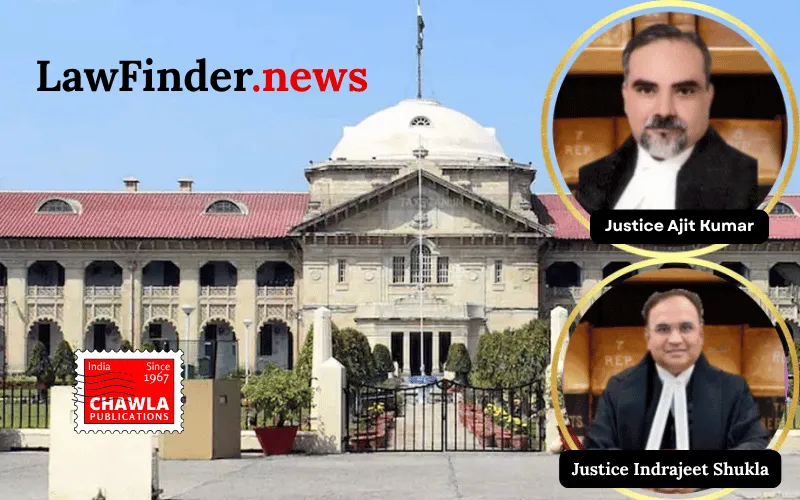
A two-judge bench comprising Justice Ajit Kumar and Justice Indrajeet Shukla stayed the order passed by the ADM (Administration), Prayagraj refusing to confirm the declaration of the petitioner who voluntarily embraced Sanatan Dharma.
The court further directed the concerned ADM to pass an order afresh taking a pragmatic view of the matter, considering the first two reports, favouring the petitioner, as well as the court's own interaction with the petitioner and his wife.
According to facts, the petitioner, Anil Pandit (earlier known as Mohammad Ahashan), is an Assistant Professor at an institute of the Allahabad University. On January 12, 2022, he made a declaration under Section 8 of the UP Prohibition of Unlawful Conversion of Religion Act, 2021 showing his intent to convert.
On February 11, 2022, the priest also gave declaratory information to the DM regarding the upcoming conversion ritual. Finally, on March 14, 2022, the conversion rituals were performed at an Arya Samaj Temple.
Between 2022 and 2023, two police inquiry reports were submitted before the DM confirming that the conversion was voluntary and without undue influence.
However, despite these clear findings in the police reports, the ADM again asked the police to submit a further report in light of a criminal case registered against the petitioner by the wife's father, even though he was not in the picture at the time of the conversion.
Ultimately, on August 9, 2024, the ADM rejected the petitioner's application for a conversion certificate relying on a subsequent police report from July 2024 that specified the factum of the FIR and the filing of a charge sheet against the petitioner.
It was contended by the petitioner's counsel that the inquiry as contemplated under Section 8(3) of the 2021 Act only mandates one inquiry to be held by the DM or ADM and further argued that the authority cannot order inquiry after inquiry, as was done in the present case, especially when the initial reports submitted by the police were in favour of the petitioner establishing that he had voluntarily converted to Hinduism.
After going through the facts of the case, the court, in its order dated May 5, observed that personal interaction with the petitioner as well as his wife had found that the couple had voluntarily married according to Hindu rites despite her father's opposition.
The petitioner also reiterated that he had a deep inclination towards Sanatan Dharma since his school days and he had voluntarily converted at an Arya Samaj temple.
Against this backdrop, the bench referred to the 2021 Act and found that the petitioner had strictly followed the step-by-step statutory procedure under Section 8.
It also took into account that the first two police inquiries explicitly concluded in favour of the petitioner.
The bench observed that the ADM misled herself by focusing on the validity of the marriage and the criminal FIR instead of strictly verifying the procedural compliance of the conversion.
Granting relief to the couple, the high court directed that the petitioner is at liberty to live his married life with his wife with dignity and the police shall not interfere.
The court also placed the ADM's rejection order in abeyance and directed the authority to pass a fresh order within three weeks. The matter is now posted for a hearing on May 27.