Court Cites Lack of Evidence and Unexplained FIR Delay as Grounds for Acquittal
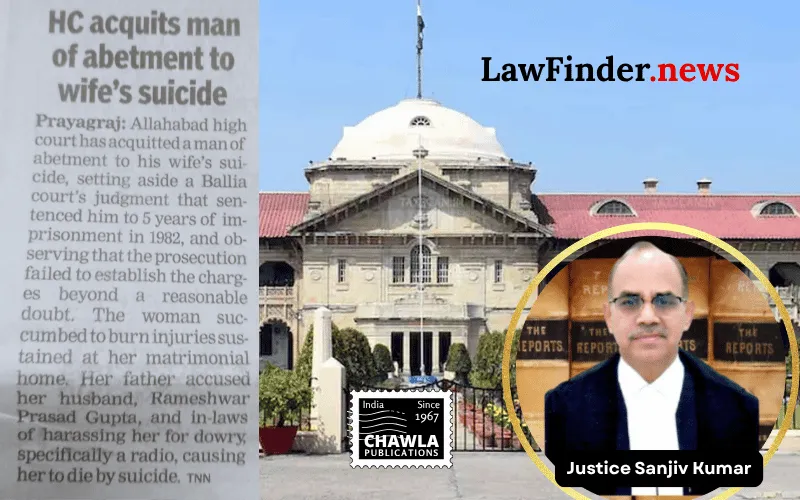
In a significant ruling, the Allahabad High Court has acquitted Rameshwar Prasad Gupta, who was previously convicted for abetting the suicide of his wife under Section 306 of the Indian Penal Code (IPC). The judgment, delivered by Justice Sanjiv Kumar, overturned the decision of the Ballia Sessions Court, which had sentenced Gupta to five years of rigorous imprisonment.
The case stemmed from the tragic death of Manju Gupta in November 1982, who allegedly committed suicide by setting herself ablaze. Her family claimed that Rameshwar and his relatives harassed her for dowry, leading to her taking the drastic step. However, the High Court noted several discrepancies in the prosecution's case, notably the 25-day delay in filing the First Information Report (FIR), which was not satisfactorily explained.
The court emphasized that mere harassment does not constitute abetment to suicide unless it is coupled with a direct act of instigation or facilitation by the accused. In this case, the prosecution failed to establish any such act by Rameshwar Prasad Gupta that would have directly led to Manju Gupta's death. Additionally, the letter written by the deceased to her mother was deemed insufficient to prove any harassment or instigation by the accused.
The judgment also highlighted the lack of a dying declaration and the absence of kerosene smell on the deceased's body, which supported the defense's claim of accidental death due to burns while cooking. The court found no evidence linking Gupta's actions to his wife's decision to commit suicide, thus failing to meet the legal requirements for abetment under Section 306 IPC.
In light of these findings, the High Court set aside the conviction and acquitted Gupta, ordering the cancellation of his bail bonds and the discharge of his sureties. The court further instructed Gupta to execute a personal bond as per the provisions of the Bharatiya Nagarik Suraksha Sanhita, 2023, in case an appeal is filed against this acquittal.
Bottom Line:
In cases of abetment of suicide under Section 306 IPC, mere harassment is insufficient to convict the accused. The prosecution must establish a deliberate or direct act by the accused that instigated or facilitated the deceased to commit suicide, and this act must be proximate to the time of the incident.
Statutory provision(s):
- Indian Penal Code, 1860 - Section 306 (Abetment of suicide)
- Criminal Procedure Code, 1973 - Section 374(2), Section 207, Section 313
- Bharatiya Nagarik Suraksha Sanhita, 2023 - Section 481
Rameshwar Prasad Gupta v. State of U.P., (Allahabad) : Law Finder Doc id # 2880461