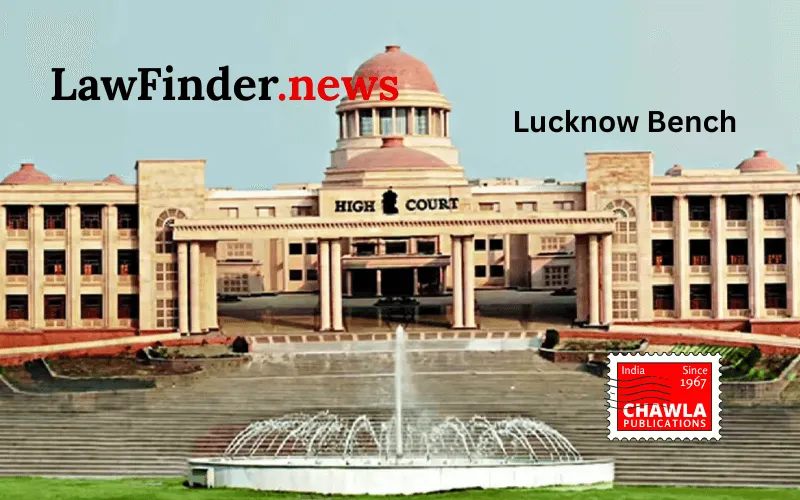
The court rules that a non-aggrieved employee lacks the locus standi to challenge employer-employee decisions.
In a significant ruling, the Allahabad High Court, Lucknow Bench, dismissed a special appeal filed by Niraj Kumar Singh, an employee of King George's Medical University (KGMU), challenging a decision favoring another employee, Anand Kumar Mishra. The bench, comprising Chief Justice Arun Bhansali and Justice Jaspreet Singh, underscored the principle that only directly affected parties have the legal standing to contest orders in service matters.
Niraj Kumar Singh, who filed the appeal, sought to challenge the reinstatement of Mishra, whose dismissal from KGMU was overturned by a Single Judge of the High Court. Singh argued that Mishra's appointment was irregular and impacted his own career prospects. However, the court emphasized that Singh, being far down the seniority list, could not demonstrate any direct adverse impact or legal injury from the reinstatement order.
The judgment clarified that speculative impacts on seniority or promotion do not confer the status of an "aggrieved person." The court reiterated that service disputes are personal and typically involve the employer and the employee directly involved. Public Interest Litigations (PILs) or appeals by third parties without direct stakes in the outcome are generally inadmissible in service-related cases, except in instances of quo warranto, where the legality of holding a public office is in question.
The court also addressed procedural aspects, such as the condonation of a 63-day delay in filing the appeal. While the delay was condoned, the main issue of locus standi dominated the proceedings. The court noted that the employer, KGMU, had not contested the Single Judge's order, which further weakened Singh's position as an appropriate appellant.
In its analysis, the court referenced multiple precedents, including the Supreme Court's stance that a "person aggrieved" is one whose legal rights are adversely affected. The bench highlighted that Singh's appeal did not meet this criterion, as his seniority and promotion prospects remained unaffected by Mishra's reinstatement.
This decision reinforces the boundaries of legal standing in service matters, emphasizing that only those with a demonstrable and direct interest can seek judicial intervention. The ruling is expected to deter frivolous litigation by employees attempting to challenge internal decisions without substantial grounds.
Bottom Line:
Locus standi in service matters - A third party employee cannot challenge orders between an employer and another employee unless directly impacted by the decision, such as affecting seniority, promotion, or legal rights.
Statutory provision(s): Article 226 of the Constitution of India, Principles of Service Jurisprudence, Precedents on Locus Standi and Aggrieved Person Doctrine.
Niraj Kumar Singh v. Anand Kumar Mishra, (Allahabad)(Lucknow)(DB) : Law Finder Doc id # 2868966