Court Upholds District Magistrate's Power to Correct Typographical Errors in Ministerial Orders
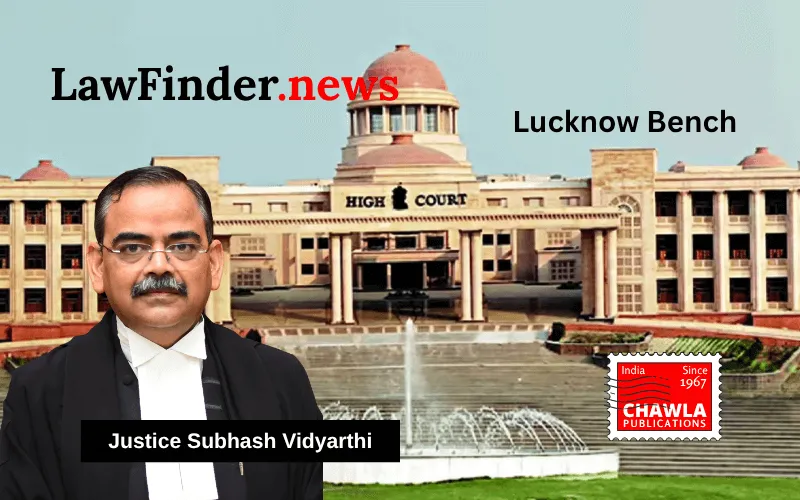
In a significant ruling, the Allahabad High Court, presided over by Justice Subhash Vidyarthi, dismissed a writ petition filed by M/S Tandon and Company against the Debt Recovery Tribunal (DRT) and HDFC Bank Ltd. The petitioners had challenged the DRT's order which upheld a correction of a typographical error made by the District Magistrate under the Securitisation and Reconstruction of Financial Assets and Enforcement of Security Interest (SARFAESI) Act, 2002.
The core issue revolved around a typographical error in the date of a possession notice under Section 13(4) of the SARFAESI Act, corrected by the District Magistrate. The petitioners contended that this correction amounted to a review of the earlier order, which they argued was beyond the jurisdiction of the District Magistrate. However, the Court clarified that correcting a typographical error does not constitute a review and falls within the ministerial powers of the District Magistrate.
The Court also addressed the petitioners' challenge to the maintainability of their writ petition under Article 227 of the Constitution, noting the availability of an alternative statutory remedy under Section 18 of the SARFAESI Act. The Court underscored that writ petitions bypassing statutory remedies should not be entertained unless exceptional circumstances, such as a violation of natural justice or jurisdictional errors, are clearly established.
The judgment further elaborated on the principles of natural justice, emphasizing the requirement for administrative or quasi-judicial authorities to record reasons for their decisions unless explicitly or implicitly excluded by statute. The petitioners argued that the DRT's rejection of their challenge lacked reasoning, constituting a violation of natural justice. However, the Court found that the DRT's reasoning was adequately provided and dismissed this contention.
The High Court's decision reaffirms the ministerial nature of powers exercised under Section 14 of the SARFAESI Act and emphasizes the necessity for parties to exhaust statutory remedies before approaching the High Courts. This judgment serves as a precedent for similar cases, reinforcing the limited scope for judicial review when statutory alternatives exist.
Bottom Line:
SARFAESI Act - Correction of typographical errors in an order passed under Section 14 of the Act does not amount to a review of the order. Such corrections, being ministerial in nature, are within the jurisdiction of the District Magistrate.
Statutory provision(s): SARFAESI Act, 2002 Section 14, Section 18; Constitution of India Article 227