Landlords Can File Eviction Applications Despite Non-Execution or Non-Submission of Tenancy Agreements; Small Cause Court Suits Pending Before Act Also Maintainable
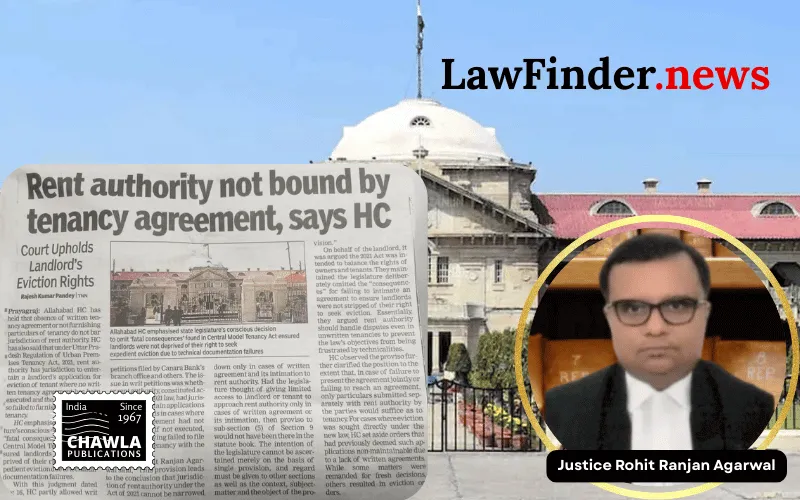
In a landmark judgment delivered on December 16, 2025, the Allahabad High Court clarified critical aspects regarding the jurisdiction of Rent Authorities constituted under the Uttar Pradesh Regulation of Urban Premises Tenancy Act, 2021 ("Act of 2021"). The Court held that the Rent Authority has jurisdiction to entertain eviction applications filed by landlords even in cases where tenancy agreements have not been executed or the particulars of tenancy have not been submitted to the Rent Authority. This ruling resolves conflicting interpretations among various courts and provides clarity for landlords and tenants in Uttar Pradesh.
The judgment arose from a cluster of six connected cases involving disputes between landlords and tenants concerning premises let out for residential or commercial purposes. The central question was whether the Rent Authority could entertain eviction applications where written tenancy agreements were not executed or intimated as required under Section 4 of the Act of 2021.
The Court traced the legislative history beginning from the Uttar Pradesh Urban Buildings (Regulation of Letting, Rent and Eviction) Act, 1972, which was replaced due to inadequacies highlighted in earlier judgments, notably Milap Chandra Jain v. State of Uttar Pradesh (2001). Responding to Supreme Court directions and inspired by the Model Tenancy Act of the Central Government, the UP legislature enacted the Act of 2021 to balance the rights of landlords and tenants and introduce a modern framework for tenancy regulation.
A key feature of the Act of 2021 is Section 4, which mandates written tenancy agreements and their submission to the Rent Authority. However, the Court noted a deliberate departure by the UP legislature from the Model Tenancy Act: whereas the Model Act imposes mandatory consequences, including barring relief for failure to submit tenancy particulars, the UP Act omits such penal consequences. Instead, Section 4(7) explicitly allows landlords to file eviction applications even if no tenancy particulars are furnished.
The Court ruled that the provisions requiring submission of tenancy particulars are directory, not mandatory. The absence of penal consequences and the legislative intent to preserve landlord rights support this interpretation. The Court further explained that Section 38(2) of the Act, which limits Rent Authority jurisdiction to disputes involving tenancy agreements submitted under the Act, does not oust jurisdiction where no such agreement exists but landlord-tenant relationship is admitted.
Moreover, the judgment upheld the maintainability of Small Cause Court (SCC) suits instituted prior to the Act's enforcement, dismissing claims that such suits are barred under Section 38. It reaffirmed that existing laws, including the Transfer of Property Act, 1882, continue to apply to unwritten tenancies not covered by the new tenancy legislation.
The Court also examined various coordinate Bench decisions and found no conflict warranting referral to a Larger Bench. It emphasized that the Act aims to balance equity between landlords and tenants, and technical non-compliance should not defeat substantive rights.
Consequently, the Court dismissed certain writ petitions challenging the jurisdiction of Rent Authorities and upheld eviction orders passed under the Act despite absence of written agreements or submission of tenancy particulars. It granted tenants limited time to vacate premises with conditions ensuring peaceful possession to landlords.
This judgment provides crucial guidance to landlords and tenants in Uttar Pradesh, affirming that Rent Authorities have wide jurisdiction to resolve tenancy disputes even in the absence of formal written agreements or submissions, reflecting the legislative intent to provide speedy and equitable resolution.
Bottom Line:
Rent Authority under Uttar Pradesh Regulation of Urban Premises Tenancy Act, 2021 has jurisdiction to entertain application filed by landlord even in cases where tenancy agreements are not executed or particulars of tenancy are not submitted to Rent Authority.
Statutory provision(s): Uttar Pradesh Regulation of Urban Premises Tenancy Act, 2021 - Sections 4(3), 4(7), 9(5), 21(2), 38(1), 38(2), 42, 46; Provincial Small Cause Courts Act, 1887 - Section 25; Transfer of Property Act, 1882 - Sections 105, 106, 107, 108