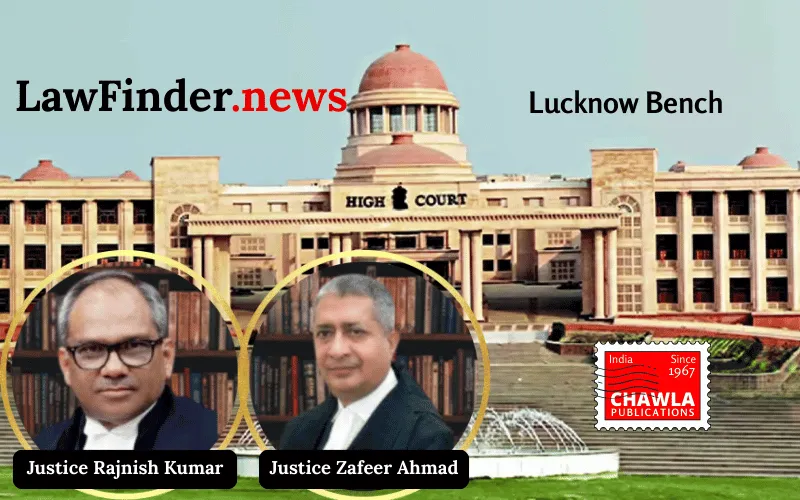
Court Questions Admissibility of Confessional Statements; Directs Cooperation in Investigation
In a recent development, the Allahabad High Court, Lucknow Bench, has issued a significant order in the case of Arpit Tiwari versus State of Uttar Pradesh and others. The court has stayed any coercive action against Arpit Tiwari in connection with FIR No. 0269 of 2025, lodged under various sections of the Bharatiya Nagarik Suraksha Sanhita, 2023, at Police Station Tarun, District Ayodhya. This order comes in light of the FIR being primarily based on the confessional statement of a co-accused, which the court found inadmissible under the law.
The division bench comprising Justices Rajnish Kumar and Zafeer Ahmad deliberated upon the petition filed by Arpit Tiwari seeking the quashing of the FIR. The court noted that the FIR's allegations are grounded on the confessional statement of a co-accused, a practice deemed unsustainable when such statements are inadmissible, and the investigation remains incomplete.
The petitioner, represented by counsel Akhand Kumar Pandey, argued that his name surfaced solely due to the confessional statement of a co-accused, and he was not initially named in the allegations. Furthermore, the evidence, such as Call Data Records (CDR) and WhatsApp chats, are yet to be procured to substantiate the claims against Tiwari. The petitioner also alleged mala fide intent on the part of a police official involved in the case.
The court, while acknowledging the petitioner's arguments, emphasized that no coercive measures should be taken against him, provided he cooperates with the ongoing investigation. The court directed Tiwari to appear before the Investigating Officer on March 15, 2026, and continue his cooperation. The bench also instructed the state to submit a counter affidavit within three weeks, and a rejoinder affidavit could be filed a week thereafter.
In its observations, the court underscored the need for a thorough examination of the case, particularly regarding the admissibility of the co-accused's confessional statement and the alleged mala fide. The court has scheduled the next hearing in the week commencing April 13, 2026.
This decision highlights the judicial scrutiny over the use of confessional statements in criminal proceedings and the emphasis on fair investigation practices.
Bottom Line:
FIR based on the confessional statement of co-accused is not sustainable when confessional statements are inadmissible under law and investigation remains incomplete.
Statutory provision(s): Sections 61(2), 109(1), 115(2), 324(4), 351(3), 352, 117(2), 191(2), 191(3), 61(2)(a), 3(5) of Bharatiya Nagarik Suraksha Sanhita, 2023.
Arpit Tiwari v. State Of U.P., (Allahabad)(DB)(Lucknow) : Law Finder Doc id # 2865589