In a landmark decision, the court affirms the validity of arbitration clauses in commercial invoices, even in the absence of a signed agreement.
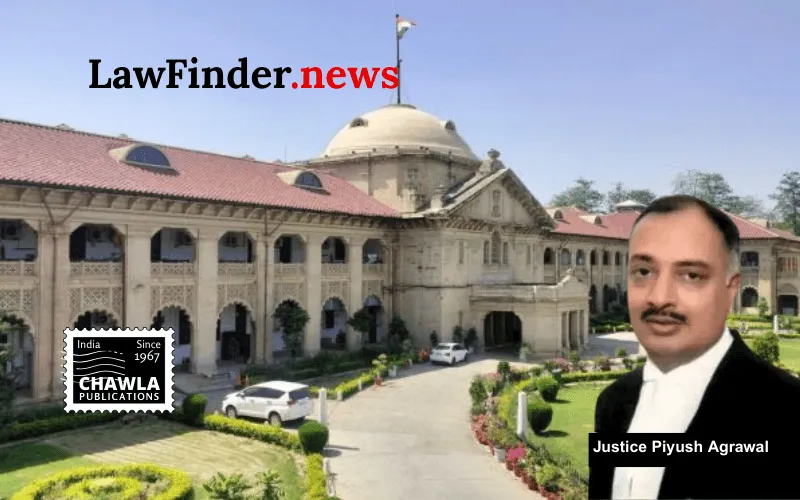
In a pivotal judgment, the Allahabad High Court has ruled that an arbitration clause included in a tax invoice constitutes a binding arbitration agreement under the Arbitration and Conciliation Act, 1996. The decision, delivered by Justice Piyush Agrawal on May 6, 2026, came in the case of M/s Ganesha Ecosphere Limited v. Ms Goodcore Spintex Pvt. Limited.
The petitioner, M/s Ganesha Ecosphere Limited, sought the appointment of an arbitrator under Section 11(6) of the Arbitration and Conciliation Act, 1996, citing an arbitration clause printed on tax invoices. The invoices were issued to Ms Goodcore Spintex Pvt. Limited for the supply of recycled polyester staple fibre. Despite the absence of a formal, signed arbitration agreement, the court found that the conduct of Ms Goodcore Spintex, which included accepting goods and making part payments, indicated consent to the terms of the invoices, including the arbitration clause.
Counsel for the applicant, Abhishek Bhushan, argued that the continuous business transactions and the lack of objection to the invoice terms from the respondent demonstrated a mutual agreement to arbitrate disputes. The court agreed, referencing several precedents from the Delhi and Bombay High Courts, as well as the Supreme Court, to support the enforceability of arbitration clauses in commercial invoices.
The respondent, represented by Sankalp Narain, contended that an arbitration clause in an invoice, without a signed agreement, was insufficient to bind the parties. However, the court, relying on the principle of competence-competence, held that the prima facie existence of an arbitration agreement was enough to refer the matter to arbitration. The court emphasized that detailed examination of the arbitration clause should be left to the arbitral tribunal.
This decision aligns with the Supreme Court's stance in similar cases, where the absence of a signed agreement does not negate the validity of an arbitration clause if the parties' conduct indicates acceptance of the invoice terms. The court appointed Justice Vivek Kumar Birla, a former judge of the Allahabad High Court, as the sole arbitrator for the dispute, subject to his consent.
The judgment sets a significant precedent for commercial disputes, reinforcing the validity of arbitration clauses in invoices and emphasizing the importance of parties' conduct in determining agreement to arbitrate.
Bottom line:-
Arbitration Clause in an Invoice - An arbitration clause printed on a tax invoice, which is accepted by the recipient through conduct (e.g., by accepting goods and making part payments), constitutes a valid arbitration agreement under the Arbitration and Conciliation Act, 1996, even in the absence of a signed agreement.
Statutory provision(s): Arbitration and Conciliation Act, 1996 Sections 11, 16, 7