Court affirms the validity of compulsory retirement under Fundamental Rule 56(j), emphasizing due process and public interest considerations.
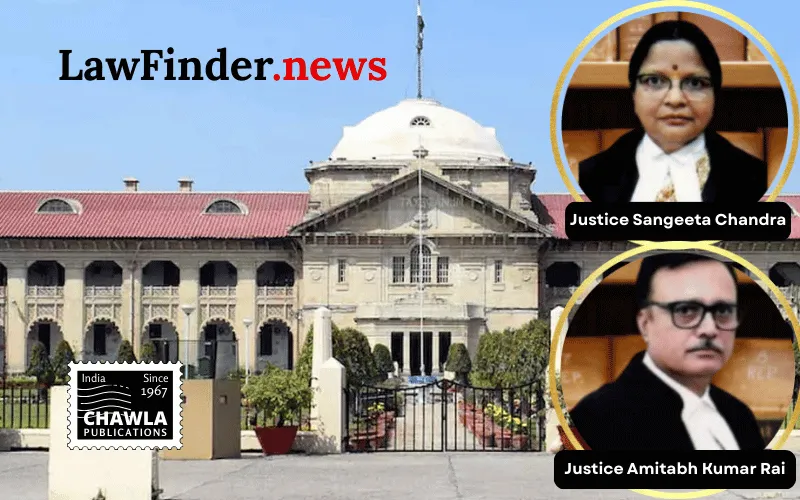
In a significant judgment delivered on February 2, 2026, the Allahabad High Court dismissed the writ petition filed by Alok Kumar Mitra, a former Commissioner of Income Tax, challenging his compulsory retirement from the Indian Revenue Service. The Division Bench, comprising Justices Mrs. Sangeeta Chandra and Amitabh Kumar Rai, upheld the decision made by the Central Administrative Tribunal, Lucknow, which had previously rejected Mitra's challenge to his retirement.
The case revolves around Mitra's compulsory retirement under Fundamental Rule 56(j), a statutory provision allowing the government to retire an officer in public interest. Mitra contended that his retirement was arbitrary, lacked due process, and was contrary to several Office Memorandums that guide such decisions. He argued that his service record post-promotion was outstanding and that the Review Committee did not follow proper procedures, including obtaining necessary approvals from the Appointments Committee of the Cabinet (ACC).
The High Court meticulously examined the statutory framework, Office Memorandums, and precedents set by the Supreme Court regarding compulsory retirement. It noted that the Review Committee had considered Mitra's entire service record, including adverse entries and charge sheets, before recommending his retirement. The court emphasized that compulsory retirement is not punitive and does not carry any stigma; rather, it is based on the subjective satisfaction of the appropriate authority regarding the public interest.
Importantly, the court clarified that while adverse entries prior to promotion can be considered, the entire service record must be evaluated. The judgment highlighted the narrow scope of judicial review in such cases, reiterating that courts cannot substitute their opinion for that of the Review Committee unless the decision is arbitrary, mala fide, or unsupported by evidence.
The court found no procedural irregularities or illegalities in Mitra's compulsory retirement. It noted that the Review Committee had valid reasons to doubt Mitra's integrity and effectiveness, considering his involvement in several controversies and complaints during his tenure. The court underscored that the decision was taken in public interest and followed the prescribed procedures, including recommendations from the Representation Committee.
Ultimately, the Allahabad High Court's judgment reinforces the government's authority to compulsorily retire officers under Fundamental Rule 56(j) when their continuation in service is deemed contrary to public interest. The court's decision aligns with established legal principles, emphasizing the importance of maintaining integrity and effectiveness within public service.
Bottom Line:
Compulsory retirement under Fundamental Rule 56(j) - Validity of compulsory retirement upheld when due process is followed, entire service record is considered, and decision is based on material evidence.
Statutory provision(s): Fundamental Rule 56(j), Office Memorandums dated 10.05.1974, 21.03.2014, 11.09.2015, Central Civil Services (Pension) Rules.
Alok Kumar Mitra v. Union of India, (Allahabad)(Lucknow)(DB) : Law Finder Doc id # 2848167