Court affirms that revenue entries without legal basis, despite being long-standing, cannot be presumed genuine.
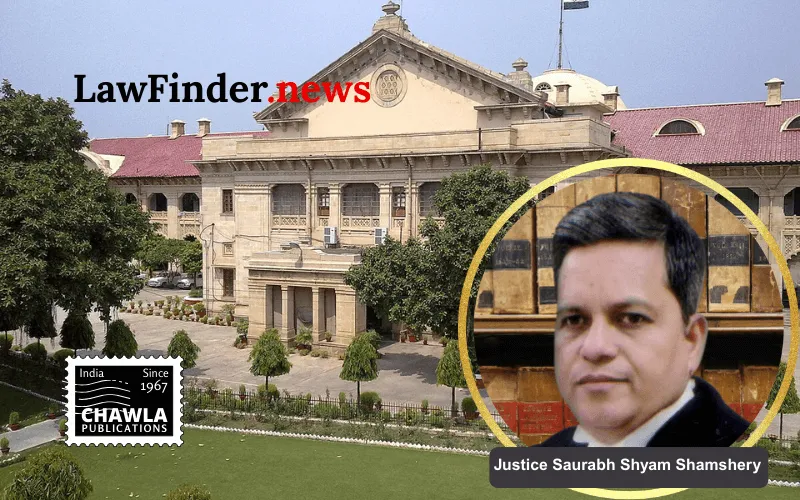
In a significant decision, the Allahabad High Court has dismissed a writ petition challenging the orders of consolidation authorities that expunged the names of the petitioners' predecessors from revenue records. The judgment, delivered by Justice Saurabh Shyam Shamshery, underscores the legal principle that long-standing revenue entries cannot be presumed to be genuine if they lack a factual or legal basis, even if they have been in place for many years.
The case, arising from objections filed under Section 9A(2) of the U.P. Consolidation of Holdings Act, 1953, involved the petitioners challenging the orders of the Consolidation Officer, Settlement Officer of Consolidation, and Deputy Director of Consolidation. These authorities had expunged the names of the petitioners' predecessors from the revenue records, citing that the entries were made surreptitiously and without legal justification.
Counsel for the petitioners argued that their predecessors had been recorded in the revenue entries for an extended period, from 1309-F to 1388-F, and that this long-standing record should be presumed genuine. However, the court emphasized that the presumption of correctness applies only to genuine entries, not those made fraudulently or without a legal basis.
The court noted that the petitioners failed to provide substantive evidence beyond the revenue records to establish their claims of co-tenancy and common ancestry with the respondents. The entries in question, which included the petitioners' predecessors as 'sikmi cultivators' for a fixed period, were deemed insufficient to confer co-tenure holder status.
Justice Shamshery highlighted the limited jurisdiction of the writ court to interfere with concurrent findings by authorities under the U.P. Consolidation of Holdings Act, stressing that such interference is warranted only if the findings are perverse or beyond jurisdiction. The court found no such perversity in the authorities' decisions.
The judgment aligns with precedents set by the Supreme Court, reinforcing the principle that revenue records, while generally presumed correct, can be challenged if proven to be made without a factual or legal basis. The court referenced cases such as Vishwa Vijay Bharati v. Fakhrul Hassan and Dharam Singh v. Prem Singh to support its decision.
In conclusion, the Allahabad High Court's dismissal of the writ petition reaffirms the principle that revenue entries must be backed by substantive evidence and a legal basis to be deemed genuine. The decision underscores the importance of transparency and legality in the maintenance of revenue records.
Bottom Line:
Revenue entries cannot be presumed to be genuine if made surreptitiously and without legal basis, even if they are long-standing. Concurrent findings of authorities under U.P. Consolidation of Holdings Act, 1953, cannot be interfered with unless shown to be perverse.
Statutory provision(s):
U.P. Consolidation of Holdings Act, 1953 Section 9A(2)
Bachcha Lal v. State of Uttar Pradesh, (Allahabad) : Law Finder Doc id # 2875951