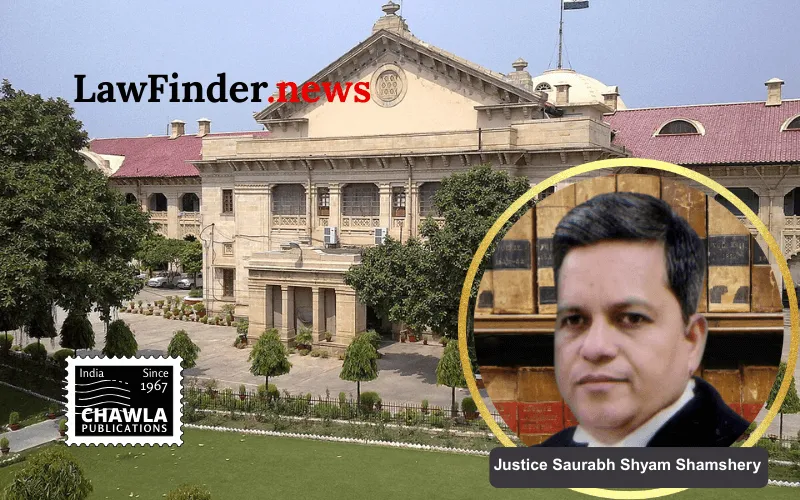
Landmark judgment reinforces the stringent requirements for proving adverse possession under U.P. land laws.
In a significant ruling, the Allahabad High Court has overturned a decision by the Deputy Director of Consolidation (DDC) concerning the long-standing land dispute involving adverse possession claims under the U.P. Consolidation of Holdings Act, 1953, and the U.P. Zamindari Abolition and Land Reforms Act, 1951. The High Court judgment, delivered by Justice Saurabh Shyam Shamshery, addresses the crucial elements required to establish adverse possession and the presumption of correctness for revenue entries.
The case, which has been pending for over four decades, involved objections raised during consolidation proceedings concerning several plots of land in Azamgarh District. The plots were originally recorded in the names of Radhey Kishun Upadhyay and Shridhar Upadhyay, predecessors of the petitioner D.B. Upadhyaya. The contesting respondents claimed adverse possession, asserting rights as Adhivasi and Sirdar based on historical entries in the revenue records.
The Consolidation Officer and the Settlement Officer of Consolidation initially rejected the respondents' claims, emphasizing the lack of continuous and hostile possession for more than 12 years, as required to prove adverse possession. These findings were later challenged in revision petitions before the DDC, who partially allowed the claims, leading to the current writ petition before the High Court.
In its judgment, the High Court meticulously analyzed the requirements for proving adverse possession, reaffirming that possession must be continuous, hostile, and open for over 12 years. The court found that the DDC's decision was based on incomplete evidence and assumptions without adequately considering the nature of revenue entries, which included notations of "Batai Nisfi" indicating permissive possession rather than adverse.
The court cited several precedents, including the Supreme Court's rulings on the necessity of genuine, non-fictitious entries in revenue records to confer rights such as Adhivasi or Sirdar. The judgment emphasized that fraudulent or surreptitious entries cannot establish possessory titles and that the presumption of correctness applies only to genuine entries.
Justice Shamshery noted that the Deputy Director of Consolidation had failed to properly assess the legal and factual context of the entries, resulting in an erroneous conclusion. The High Court's decision to reinstate the findings of the lower consolidation authorities underscores the importance of adhering to legal standards in land rights disputes.
This ruling is expected to have significant implications for similar cases involving adverse possession claims in Uttar Pradesh, highlighting the judiciary's commitment to uphold the integrity of land records and the rule of law in property disputes.
Bottom Line:
Adverse possession must be proved with continuous, hostile possession for over 12 years. Mere entries in revenue records without evidence of continuity or hostility are insufficient to establish rights like Adhivasi or Sirdar under U.P. Zamindari Abolition and Land Reforms Act, 1951.
Statutory provision(s): U.P. Consolidation of Holdings Act, 1953 Section 48, U.P. Zamindari Abolition and Land Reforms Act, 1951 Section 20(b)
D.B.Upadhyaya v. D.D.C., (Allahabad) : Law Finder Doc id # 2876794