Court Imposes Cost on Petitioner for Frivolous Litigation; Emphasizes Judicial Restraint in Academic Matters
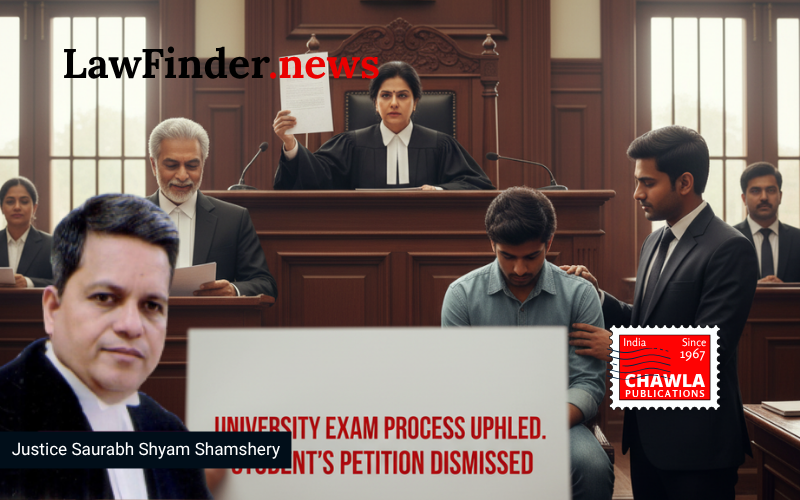
In a significant judgment, the Allahabad High Court has dismissed a writ petition filed by Santosh Kumari, a law student at Chhatrapati Sahuji Maharaj University, Kanpur, who challenged her examination results. The petitioner claimed she was entitled to 499 marks out of 500 in her LLB First Semester, alleging that she was wrongly awarded only 182 marks. Justice Saurabh Shyam Shamshery presided over the case and emphasized the necessity of judicial restraint in academic matters.
The court reiterated its stance on non-interference in educational assessments, underscoring that courts are not equipped to act as experts in evaluating answer sheets, particularly when expert committees have already scrutinized them. The judgment cited several Supreme Court cases, including Vikesh Kumar Gupta v. State of Rajasthan and Ran Vijay Singh v. State of Uttar Pradesh, highlighting the courts' limited role in re-evaluation processes unless a clear illegality or irregularity is evident.
Despite the petitioner's repeated disruptions during the proceedings, the court maintained its focus on the legal principles governing academic evaluations. The petitioner, who appeared in person, provided affidavits and documents alleging corruption and incorrect marking by the university. However, the court found these claims to be unsubstantiated, noting that the sources of the alleged correct answers were not provided.
The judgment also addressed the conduct of litigants, cautioning against frivolous litigation. It imposed a cost of Rs. 20,000 on Santosh Kumari, to be deposited in the Bank Account of the High Court Legal Services Committee, as a deterrent against such practices. Justice Shamshery advised the petitioner to concentrate on her studies and improve her performance through diligent preparation, rather than resorting to legal challenges without factual or legal basis.
This judgment serves as a reminder of the courts' role in maintaining the integrity of academic processes and the importance of expert opinions in educational assessments. It reinforces the principle that judicial sympathy cannot override established procedures, ensuring fairness and finality in examination results.
Bottom Line:
Courts should exercise restraint in academic matters, particularly in cases involving expert opinions, answer keys, and OMR sheet evaluations. Judicial interference in examination processes and expert recommendations is discouraged unless there is a clear and significant irregularity.
Statutory provision(s): Article 226 of the Constitution of India, Prohibition Act, 1961
Santosh Kumari v. State of U.P., (Allahabad) : Law Finder Doc Id # 2805238