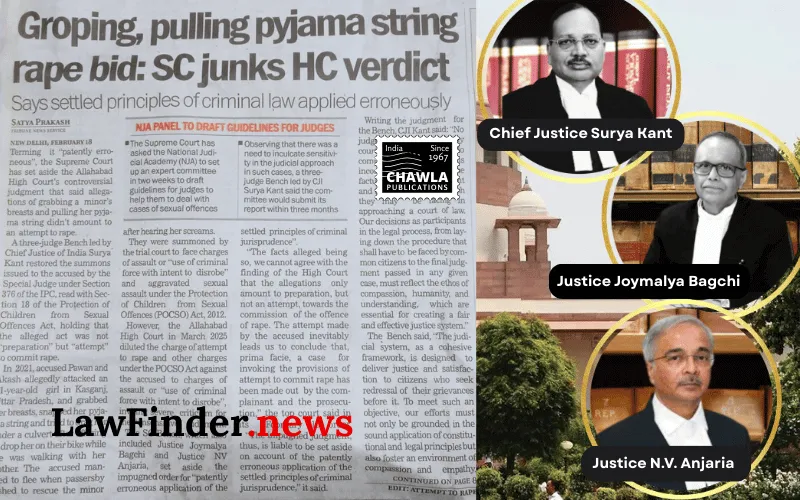
Supreme Court Overrules Allahabad High Court's Judgment on Sexual Offence Case Involving Minor, Supreme Court Restores Original Charges, Calls for Judicial Sensitivity and Compassion in Cases Involving Vulnerable Victims
In a significant judgment, the Supreme Court of India has set aside a controversial decision by the Allahabad High Court that modified the charges against two accused in a case involving sexual offences against a minor. The High Court had downgraded the charges from an attempt to commit rape to lesser offences of sexual assault, a move that was heavily criticized for lacking legal and judicial sensitivity.
The Supreme Court, led by Chief Justice of India Surya Kant, along with Justices Joymalya Bagchi and N.V. Anjaria, reinstated the original charges under Section 376 of the Indian Penal Code (IPC) read with Section 18 of the Protection of Children from Sexual Offences (POCSO) Act. The Court found the High Court's interpretation of the actions as mere 'preparation' rather than an 'attempt' to commit rape to be legally erroneous.
The judgment was initiated suo motu after concerns were raised by 'We the Women of India', an organization advocating for women's rights. The organization, through its president, Ms. Shobha Gupta, highlighted the insensitivity and potential ramifications of the High Court's decision.
During the proceedings, the Supreme Court emphasized the need for sensitivity and empathy in judicial decisions, especially in cases involving vulnerable victims like minors. The Court noted that insensitivity in such matters could undermine efforts to protect victims of sexual offences.
In a broader directive, the Supreme Court has tasked the National Judicial Academy in Bhopal with forming a Committee of Experts. This committee, chaired by former Supreme Court Judge Justice Aniruddha Bose, is to develop guidelines that promote sensitivity and compassion in judicial processes concerning sexual offences and other cases involving vulnerable victims.
The Court's decision underscores the importance of a compassionate judicial approach and aims to ensure that legal proceedings do not inadvertently harm victims further. The guidelines are expected to address linguistic barriers and ensure that victims can effectively communicate their experiences without facing additional trauma.
The Supreme Court has requested the expert committee to submit its report within three months, aiming for a comprehensive and empathetic framework that judicial officers can adopt across the country.
Bottom Line:
Judicial decisions involving sexual offences must reflect sensitivity, compassion, and empathy towards victims, especially vulnerable ones. Courts need to differentiate between 'preparation' and 'attempt' in criminal jurisprudence accurately.
Statutory provision(s): Indian Penal Code, 1860 - Sections 376, 354B; Protection of Children from Sexual Offences Act, 2012 - Sections 9, 10, 18; Code of Criminal Procedure, 1973 - Section 156(3)