Husband's appeal for divorce succeeds as court finds no evidence of "wrong" under Hindu Marriage Act provisions
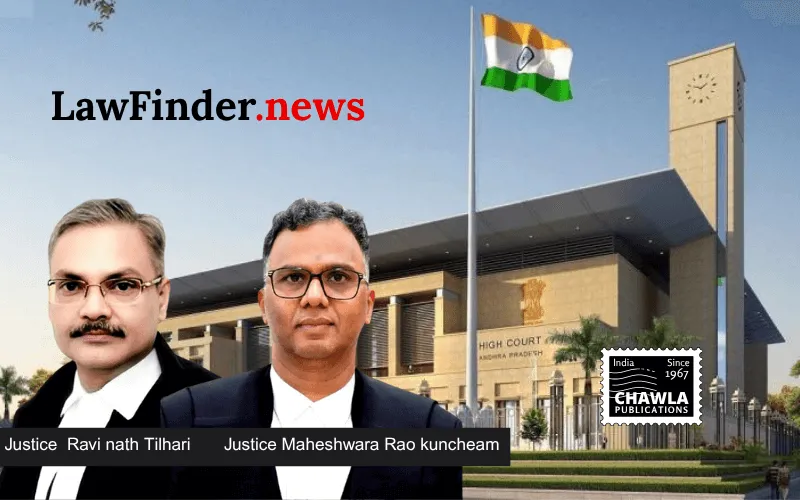
In a significant ruling, the Andhra Pradesh High Court has granted a divorce to T. Ravi, the appellant, overturning a previous dismissal by the Family Court in Tirupati. The judgment was delivered by a Division Bench comprising Justices Sri Ravi Nath Tilhari and Sri Maheswara Rao Kuncheam. The case involved complex marital disputes between T. Ravi and his wife, T. Lakshmi Devi, revolving around compliance with a decree for restitution of conjugal rights.
The couple, married since February 1992, faced increasing discord, leading the wife to file a petition for restitution of conjugal rights, which was granted by the Family Court in July 2001. However, the husband subsequently sought divorce under Section 13(1A)(ii) of the Hindu Marriage Act, claiming non-compliance by the wife for over a year following the decree.
Initially, the Family Court dismissed Ravi's petition for divorce, citing that he might be taking advantage of his own wrong under Section 23(1)(a) of the Act. The court relied on testimonies from Lakshmi Devi and other witnesses, suggesting that she attempted reconciliation but was rebuffed by Ravi.
Upon appeal, the High Court meticulously reviewed the evidence, focusing on the credibility and consistency of witness testimonies. It noted contradictions in the evidence provided by Lakshmi Devi and her witnesses, which undermined her claim of having made genuine efforts to resume conjugal life. The court emphasized that mere disinclination by Ravi to reunite does not constitute a "wrong" under Section 23(1)(a), as the alleged misconduct must be serious enough to justify denial of divorce.
The Bench referred to precedents like Dharmendra Kumar v. Usha Kumar and Smt. Saroj Rani v. Sudarshan Kumar Chadha, underscoring that non-compliance with a restitution decree alone does not amount to a "wrong." It also highlighted that Lakshmi Devi did not pursue execution of the restitution decree, which could have enforced compliance through legal means.
Ultimately, the High Court concluded that Ravi was entitled to divorce, as the statutory requirements under Section 13(1A)(ii) were met, and no credible evidence of "wrong" was established against him. The judgment sets a crucial precedent, clarifying the interpretation of "wrong" in matrimonial disputes and reinforcing the legal avenue for seeking divorce when restitution of conjugal rights remains unfulfilled.
Bottom line:-
A decree of divorce can be granted under Section 13(1A)(ii) of the Hindu Marriage Act if there has been no restitution of conjugal rights for a period of one year after the decree for restitution of conjugal rights, provided the petitioner is not taking advantage of his or her own wrong as per Section 23(1)(a) of the Act.
Statutory provision(s): Hindu Marriage Act, 1955 Sections 13(1A)(ii), 23(1)(a); Evidence Act, 1872 Section 3; Code of Civil Procedure, Order 21, Rule 31
T. Ravi v. T. Lakshmi Devi, (Andhra Pradesh)(DB) : Law Finder Doc id # 2892382