The court emphasizes the protection of child's identity over parental disputes, dismissing the petition for a DNA test in a partition suit.
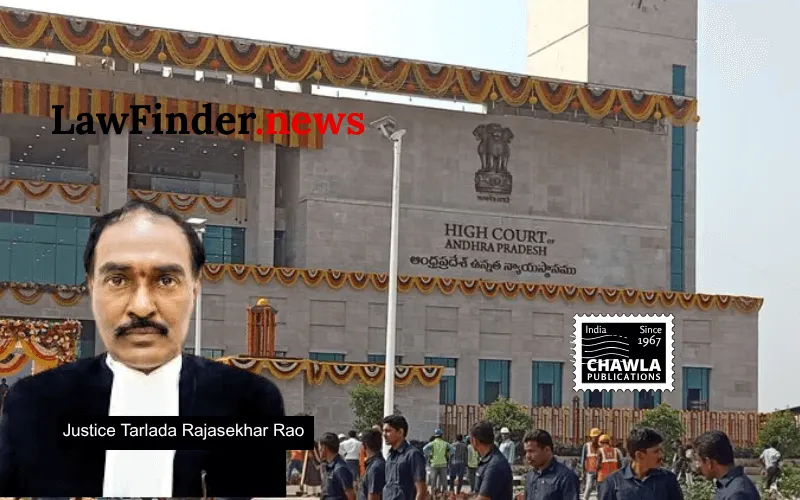
In a recent judgment, the Andhra Pradesh High Court, presided over by Justice Tarlada Rajasekhar Rao, dismissed a Civil Revision Petition filed by Saradaga Narasayya Reddy, who challenged the trial court's decision to reject his application for a DNA test in a partition suit. The case involved Saradaga Narasayya Reddy as the petitioner and Dingu Kanaka Mahalakshmi as the respondent.
The dispute arose when the respondent, Dingu Kanaka Mahalakshmi, filed a suit seeking partition of certain properties, claiming to be the daughter of Saradaga Narasayya Reddy. The petitioner denied this claim, asserting that the respondent was not his biological daughter but was born to his elder brother. In an attempt to disprove the respondent's claim of paternity, Reddy filed an application under Order XXVI Rule 10-A read with Section 151 of the Civil Procedure Code, requesting a DNA test to ascertain the respondent's parentage.
The trial court, however, dismissed the application, stating that the burden of proof lies with the respondent-plaintiff to substantiate her claim for partition with credible evidence. The court further noted that ordering a DNA test could adversely affect the child's reputation and social status, a principle supported by precedents from the Supreme Court of India.
Citing decisions from the Supreme Court, particularly in the cases of Aparna Ajinkya Firodia v. Ajinkya Arun Firodia and Goutam Kundu v. State of West Bengal, the Andhra Pradesh High Court reiterated that DNA tests should not be ordered routinely. The court emphasized that the legitimacy of a child born during a valid marriage is presumed under Section 112 of the Evidence Act, and this presumption should not be easily challenged without compelling reasons.
The court concluded that the petitioner had alternative means to disprove the paternity claim and that the trial court's dismissal of the application was justified. Consequently, the Civil Revision Petition was dismissed, with costs imposed on the petitioner for unnecessary litigation.
The judgment underscores the judiciary's focus on protecting the identity and reputation of children involved in parental disputes, reaffirming that their rights should not be compromised for the convenience of establishing parental claims.
Bottom line:-
Application for DNA test to disprove paternity in a partition suit cannot be allowed when the petitioner can adduce evidence in other manners - Courts should not order DNA tests as a matter of course, as it may harm the child's reputation and social status.
Statutory provision(s): Civil Procedure Code, 1908 Order XXVI Rule 10-A, Section 151; Evidence Act, 1872 Section 112
Saradaga Narasayya Reddy v. Dingu Kanaka Mahalakshmi, (Andhra Pradesh) : Law Finder Doc id # 2901900