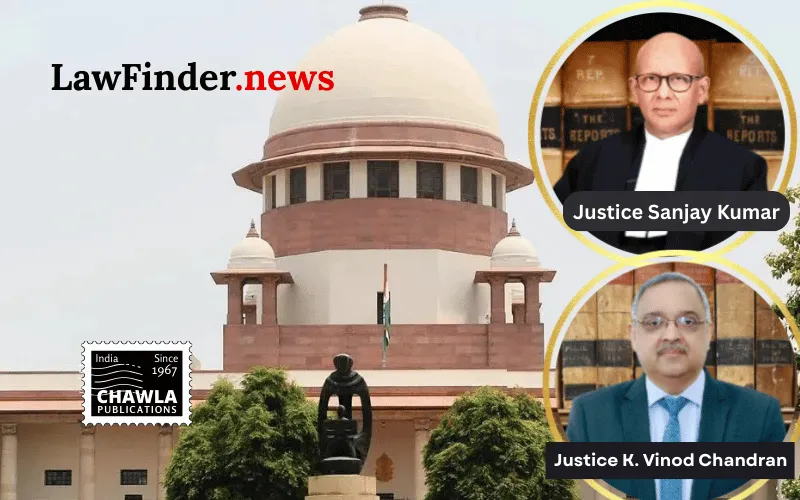
Supreme Court Overturns Bombay High Court Decision, Upholds Arbitration Clause in Real Estate Dispute, Hirani Developers and Nehru Nagar Samruddhi CHS Ltd. to Resolve Disputes via Sole Arbitrator Appointed by Supreme Court
In a landmark decision, the Supreme Court of India has set aside a previous ruling by the Bombay High Court, paving the way for arbitration between Hirani Developers and Nehru Nagar Samruddhi Co-operative Housing Society Ltd. regarding redevelopment agreements. The apex court, led by Justices Sanjay Kumar and K. Vinod Chandran, ruled in favor of Hirani Developers, stating that the arbitration clause from an earlier Development Agreement was indeed incorporated into subsequent Permanent Alternate Accommodation Agreements.
The case dates back to December 2011 when Hirani Developers entered into a Development Agreement with Nehru Nagar Samruddhi CHS Ltd. for the redevelopment of a dilapidated housing project. This agreement included a dispute resolution mechanism via arbitration under Clause 36. Later, Hirani Developers signed Permanent Alternate Accommodation Agreements with individual society members, which clearly stated that all terms of the original Development Agreement, including the arbitration clause, were binding.
However, disputes arose when society members filed complaints under the Consumer Protection Act, 2019. Hirani Developers responded by seeking arbitration, invoking the clause from the Development Agreement. The Bombay High Court initially dismissed these applications, arguing that the arbitration clause was not specifically included in the agreements with individual members. The High Court opined that Section 7(5) of the Arbitration and Conciliation Act, 1996, which requires clear intention to incorporate an arbitration clause from another document, was not satisfied.
The Supreme Court disagreed, referencing precedents such as M.R. Engineers and Contractors Private Limited v. Som Datt Builders Limited and NBCC (India) Limited v. Zillion Infraprojects Private Limited. The Court noted that the Permanent Alternate Accommodation Agreements explicitly incorporated all terms of the Development Agreement, including the arbitration clause, thereby satisfying the requirements of Section 7(5).
Justice Sanjay Kumar stated, "This was not a case of mere reference to an earlier document but a case where the parties to the later contract clearly intended to import the Development Agreement, body and soul, into the later agreements."
The Supreme Court appointed Mr. Vishal Kanade as the Sole Arbitrator to resolve the disputes between the parties. Mr. Kanade will act in accordance with the provisions of the Arbitration and Conciliation Act, 1996, ensuring a fair and expedient resolution to the disagreements that have persisted since the agreements were signed.
This ruling underscores the importance of clarity and intention in contractual agreements, particularly regarding dispute resolution mechanisms. The case serves as a reminder of the binding nature of arbitration clauses when properly incorporated into contracts, offering a streamlined path to resolving complex disputes outside of traditional court settings.
Bottom Line:
Arbitration clause in an earlier document can be incorporated into a later agreement if there is a clear and unequivocal intention of the parties to adopt all terms and conditions of the earlier agreement, including the arbitration clause.
Statutory provision(s): Arbitration and Conciliation Act, 1996 Section 7, Section 11
Hirani Developers v. Nehru Nagar Samruddhi CHS Ltd., (SC) : Law Finder Doc id # 2897361