Supreme Court Upholds Arbitration Clause in Lease Dispute, Validates High Court's Arbitrator Appointment Arbitration Agreement in Leave and License Agreement Stands Despite Jurisdictional Challenge Under Presidency Small Cause Courts Act
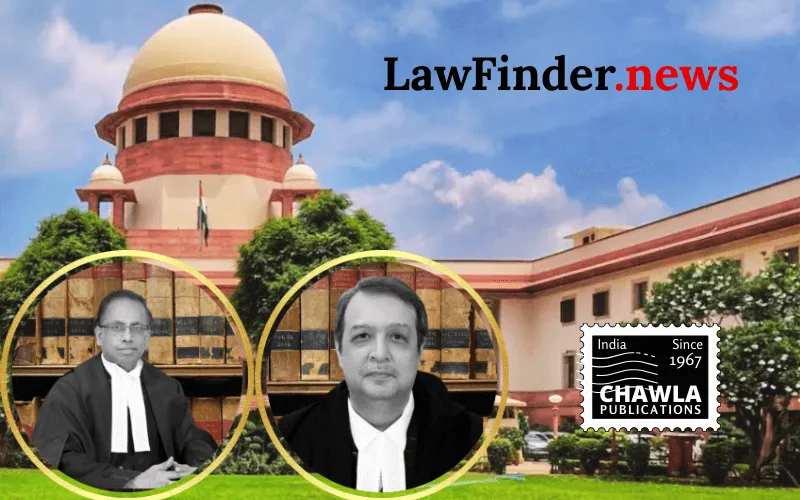
In a landmark decision, the Supreme Court of India has upheld the validity of an arbitration clause embedded in a Leave and License Agreement, affirming the Bombay High Court's appointment of an arbitrator to resolve the dispute between Motilal Oswal Financial Services Limited and Santosh Cordeiro. The judgment, delivered by Justices J. B. Pardiwala and K. V. Viswanathan, dismissed objections raised by Motilal Oswal Financial Services Limited regarding the jurisdiction of the Small Causes Court under Section 41 of the Presidency Small Cause Courts Act, 1882.
The dispute arose over a Leave and License Agreement pertaining to a property in Malad, Mumbai. Motilal Oswal Financial Services Limited, the appellant, had terminated the agreement citing the COVID-19 pandemic and invoked the force majeure clause, whereas the respondents, Santosh Cordeiro and others, demanded compensation for the balance lock-in period. The High Court, in its earlier order, appointed an arbitrator under Section 11 of the Arbitration and Conciliation Act, 1996, which was contested by the appellant on grounds of non-arbitrability.
The Supreme Court's judgment emphasized the competence-competence principle, which allows arbitral tribunals to rule on their jurisdiction, including the existence and validity of arbitration agreements. The court clarified that Section 41 of the 1882 Act does not invalidate arbitration clauses by its own force and that disputes related to monetary claims can indeed be arbitrable. The court further emphasized that the existence of an arbitration agreement should be the primary focus in proceedings under Section 11 of the Arbitration and Conciliation Act, 1996.
This decision has significant implications for contractual disputes involving arbitration clauses, affirming the autonomy of arbitration agreements even amidst jurisdictional challenges posed by special statutes. The court reiterated that substantive issues regarding arbitrability should be left to the arbitral tribunal to decide, thus upholding the doctrine of kompetenz-kompetenz.
The judgment also clarified the standing of the Full Bench decision of the Bombay High Court in Central Warehousing Corporation v. Fortpoint Automotive Pvt. Ltd., stating that it does not nullify arbitration clauses but rather emphasizes the need for specific forums to handle certain disputes unless an arbitration agreement exists.
The Supreme Court's ruling underscores the judiciary's support for arbitration as a preferred mode of dispute resolution, aligning with legislative intent to minimize judicial intervention and uphold parties' contractual agreements. The appointed arbitrator has been directed to proceed with the adjudication of the disputes and conclude the proceedings within six months.
Bottom Line:
Arbitration clause in Leave and License Agreement upheld. High Court's appointment of arbitrator under Section 11 of Arbitration and Conciliation Act, 1996 held valid, despite objections based on Section 41 of Presidency Small Cause Courts Act, 1882.
Statutory provision(s): Arbitration and Conciliation Act, 1996 Section 11, Arbitration and Conciliation Act, 1996 Section 16, Presidency Small Cause Courts Act, 1882 Section 41, Contract Act, 1872 Section 28
Motilal Oswal Financial Services Limited v. Santosh Cordeiro, (SC) : Law Finder Doc Id # 2833310