Supreme Court Upholds Auction Sale Amidst Legal Challenges. Appellant's Failure to Utilize Statutory Remedies Bars Challenge Through Writ Jurisdiction
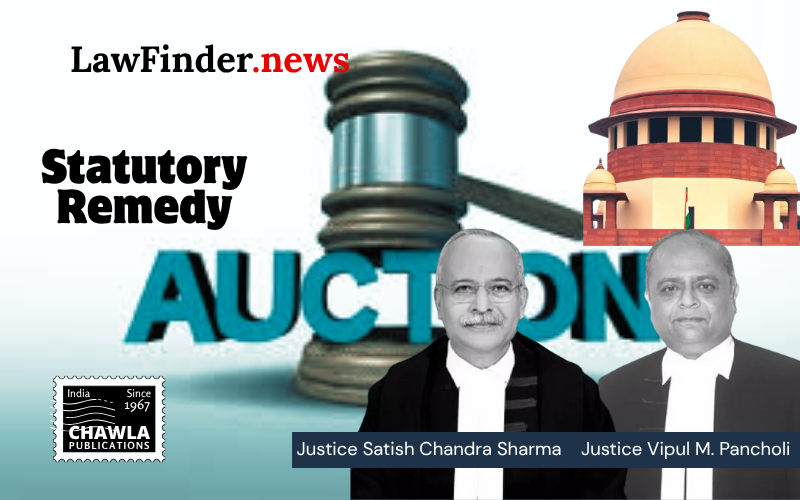
In a significant ruling, the Supreme Court of India, comprising Justices Satish Chandra Sharma and Vipul M. Pancholi, has upheld the auction sale of properties belonging to the late Ramaswamy Udayar, dismissing the appeal filed by his widow, Kolanjiammal. The judgment, delivered on November 14, 2025, reinforces the necessity of invoking statutory remedies within prescribed periods to challenge auction proceedings.
The case traces back to 1972-73 when Ramaswamy Udayar defaulted on payments for arrack shops, resulting in an ex-parte decree in 1987 for Rs. 56,170.20. After his death in 1988, the revenue authorities initiated recovery proceedings against his widow and heirs, culminating in an auction notice in 2005. Despite interim orders and partial deposits, the property was auctioned in July 2005, with the sale confirmed in July 2008.
The appellant, Kolanjiammal, argued that the auction was illegal due to ongoing writ proceedings and interim orders staying confirmation. However, the Supreme Court emphasized that statutory remedies under Sections 37-A and 38 of the Tamil Nadu Revenue Recovery Act, 1864, provide a complete mechanism to challenge such sales, mandating action within 30 days. The failure to file necessary applications within this period barred subsequent challenges via writ jurisdiction under Article 226 of the Constitution.
The Court further clarified that the interim order staying confirmation of the sale did not negate the statutory obligation to file applications under the Revenue Recovery Act. The appellant's reliance on deposits made during interim orders was insufficient to override the statutory mandate.
In reinforcing the statutory framework, the Court cited precedents, emphasizing that revenue recovery processes should not be thwarted by interim judicial orders unless clear illegality is demonstrated. The judgment underscores the principle that once a sale is confirmed, rights accrue to the auction-purchaser, protected from belated challenges unless fraud or substantial irregularity is proven.
The appellant's additional contention regarding limitation under the Limitation Act and the Civil Procedure Code was dismissed, as the certified arrears were recoverable under the Revenue Recovery Act.
Ultimately, the Supreme Court upheld the concurrent findings of the Madras High Court, affirming the validity of the auction and subsequent property sale. The judgment serves as a critical reminder of the importance of timely statutory action in contesting revenue recovery proceedings.
Bottom Line:
Failure to invoke statutory remedies under the Tamil Nadu Revenue Recovery Act, 1864 within the prescribed limitation period bars subsequent challenges to auction proceedings through writ jurisdiction under Article 226 of the Constitution of India.
Statutory provision(s):
- Tamil Nadu Revenue Recovery Act, 1864, Sections 37-A and 38
- Article 226 of the Constitution of India
- Limitation Act, 1963, Article 112
- Civil Procedure Code, 1908
Kolanjiammal (D) v. Revenue Divisional Officer, (SC) : Law Finder Doc Id # 2808513