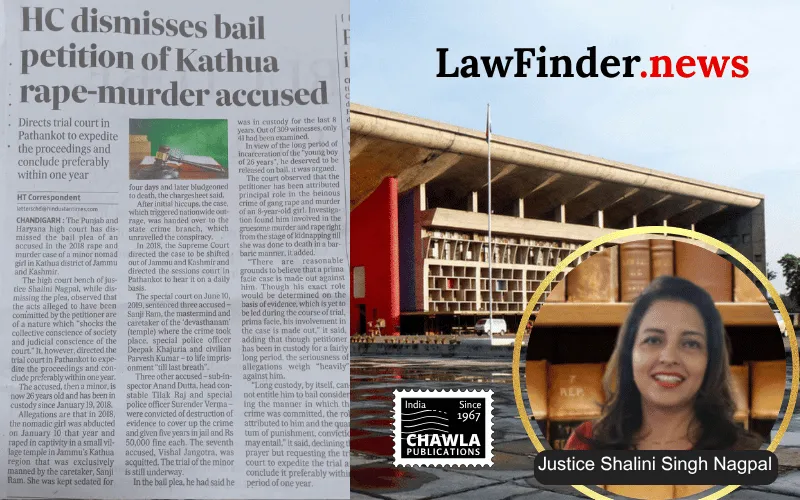
Punjab and Haryana High Court Emphasizes the Need for Cautious Judicial Discretion in Bail Matters for Serious Crimes
In a significant ruling on April 23, 2026, the Punjab and Haryana High Court, presided over by Justice Shalini Singh Nagpal, denied the bail application of Shubam Sangra alias Shuboo, accused in the infamous Kathua case involving the gang rape and murder of an 8-year-old girl. The case, which has gripped the nation due to its brutality, witnessed the petitioner seeking regular bail citing prolonged incarceration.
The petitioner, Shubam Sangra, had been in custody since January 19, 2018, facing charges under multiple sections of the Ranbir Penal Code, including kidnapping, gang rape, and murder. Despite an eight-year detention, the High Court underscored that personal liberty, though a cherished constitutional principle, must be balanced against the gravity of the offense and societal interests.
Justice Nagpal, in her judgment, highlighted that while the right to a speedy trial is integral to the right to life under Article 21 of the Indian Constitution, the nature and gravity of the charges necessitate a careful exercise of judicial discretion. The court noted that the petitioner played a principal role in the crime, and the evidence collected so far pointed towards a prima facie case against him. The evidence included DNA matches and witness testimonies that firmly placed Sangra at the scene of the crime.
The defense argued for bail on grounds of extended custody and the slow pace of the trial, mentioning that only 41 out of 309 witnesses had been examined. They also pointed out the absence of male DNA evidence linking Sangra directly to the crime. However, the prosecution countered with compelling evidence, including DNA results from hair strands and testimonies that corroborated the petitioner's involvement.
The High Court referenced several Supreme Court precedents, emphasizing that the severity of the crime and the potential for the accused to tamper with evidence or influence witnesses were crucial considerations. The court reaffirmed that prolonged detention alone does not warrant bail in cases of serious offenses.
In a bid to address the delays in the judicial process, the High Court directed the trial court to expedite proceedings and conclude the trial within a year. This directive aims to ensure that justice is served promptly while balancing the rights of the accused and the victim's family.
The judgment serves as a poignant reminder of the judiciary's role in safeguarding societal interests while upholding constitutional rights. The High Court's decision reflects a commitment to justice in cases that challenge the moral fabric of society.
Bottom Line:
Bail application in cases of heinous crimes involving prolonged incarceration must be decided cautiously, balancing personal liberty with societal interest, victim's rights, and the gravity of the offense.
Statutory provision(s): Sections 363, 343, 376-D, 302, 201, 120-B of the Ranbir Penal Code, Section 439, Section 309 of the Criminal Procedure Code, 1973.