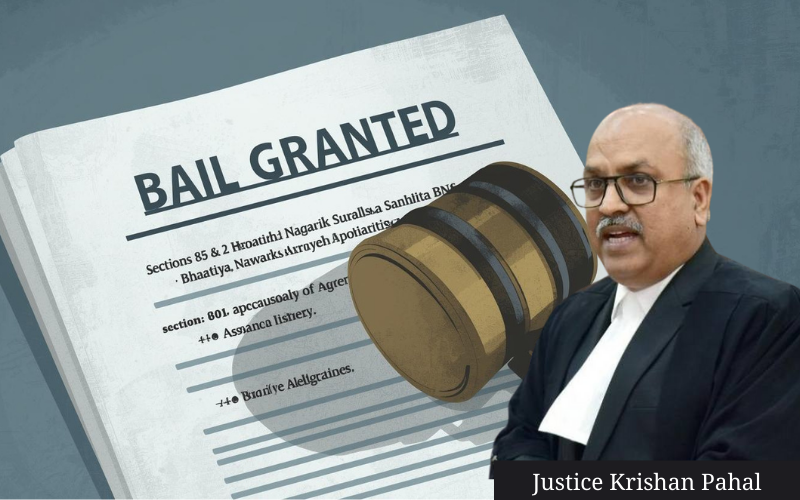
Bail in Matrimonial and Dowry Cases : Delayed FIR, and application of the principle "bail is the rule, jail is the exception.
In a significant ruling, the Allahabad High Court, through Justice Krishan Pahal, addressed the complexities surrounding bail applications in the case of Shivam @ Kallu v. State of U.P. The court's decision to grant bail underscores the fundamental legal principle that bail should be the rule and jail the exception, especially in cases where the allegations lack specificity and the accused has a clean criminal record.
Background of the Case:
The applicant, Shivam @ Kallu, faced accusations under Sections 85 and 80(2) of the Bharatiya Nagarik Suraksha Sanhita and Sections 3/4 of the Dowry Prohibition Act. The allegations stemmed from the death of his daughter-in-law, which was reported as a suicide due to asphyxia from hanging. The FIR was filed with a 13-hour delay, lacking specific allegations against the applicant, who is the deceased's father-in-law. This delay and the absence of detailed accusations played a pivotal role in the court's decision-making process.
Key Legal Considerations:
1. Presumption of Innocence and Article 21: The court emphasized the presumption of innocence until proven guilty, a cornerstone of criminal jurisprudence. Article 21 of the Indian Constitution guarantees the right to life and personal liberty, reinforcing that imprisonment should only follow a fair trial and lawful conviction. The court cited the Supreme Court's stance in Satender Kumar Antil v. CBI that bail is a rule and jail is an exception, highlighting the need to protect individual liberties.
2. Principles of Bail: The judgment reiterated that the purpose of bail is to ensure the accused's attendance at trial, not to serve as punishment. The Supreme Court, in cases like Sanjay Chandra v. CBI, has consistently affirmed that bail should not be punitive or preventive. The court must weigh factors like the nature of accusations, evidence, potential sentence, and the accused's character.
3. Overcrowding and Delays: The court acknowledged systemic issues like overcrowding in jails and delays in trials, which infringe upon under trial prisoners' rights. These factors strengthen the argument for granting bail to prevent undue hardship and uphold the principles of justice and human dignity.
4. Judicial Precedents: The decision referenced several Supreme Court judgments, such as Kahkashan Kausar @ Sonam v. State of Bihar, which caution against implicating distant relatives in matrimonial disputes without specific evidence of involvement. This approach aligns with the broader legal principle of safeguarding individual rights against unjustified detention.
Conclusion:
The Allahabad High Court's decision in Shivam @ Kallu v. State of U.P. serves as a critical reminder of the judiciary's role in balancing the scales of justice. By granting bail, the court not only upheld the applicant's rights under Article 21 but also reinforced the legal doctrine that bail should be the norm and jail the exception. This case highlights the importance of scrutinizing allegations, considering the accused's history, and ensuring that detention is not used as a default punitive measure. The ruling underscores the judiciary's commitment to protecting individual liberties while ensuring that justice is served through fair and expeditious trials.
Shivam @ Kallu v. State of U.P., (Allahabad) : Law Finder Doc id # 2762905