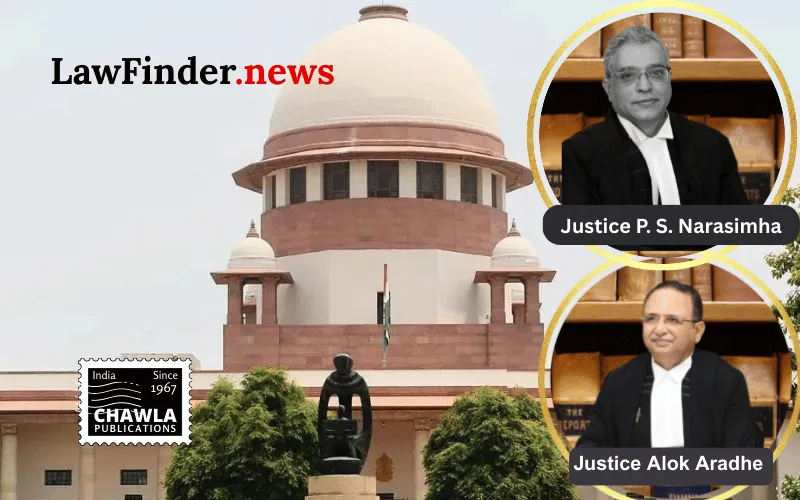
Supreme Court Overturns NCLAT Decision: Insolvency Petition Barred by Limitation, Acknowledgment by Interim Resolution Professional Does Not Extend Limitation Period, Rules Supreme Court
In a significant ruling, the Supreme Court of India has set aside the judgments of the National Company Law Appellate Tribunal (NCLAT) and the National Company Law Tribunal (NCLT), determining that the insolvency petition filed by Omkara Asset Reconstruction Pvt. Ltd. against Shrinathji Business Ventures Pvt. Ltd. and Samaria Business Ventures Pvt. Ltd. was barred by limitation. The case, titled "Shankar Khandelwal v. Omkara Asset Reconstruction Pvt. Ltd," was decided by a bench comprising Justices Pamidighantam Sri Narasimha and Alok Aradhe.
The central issue revolved around whether the application filed under Section 7 of the Insolvency and Bankruptcy Code, 2016, was within the prescribed limitation period. The appellant, Shankar Khandelwal, contended that the default occurred on December 6, 2016, with the limitation period expiring on December 6, 2019. The respondent, Omkara Asset Reconstruction, argued for a different commencement of the limitation period, considering acknowledgments during the Corporate Insolvency Resolution Process (CIRP).
The Supreme Court clarified that the limitation period for filing an application under Section 7 is three years from the date of default, as per Article 137 of the Limitation Act, 1963. The Court observed that the acknowledgment of debt by the Interim Resolution Professional (IRP) does not qualify as an acknowledgment under Section 18 of the Limitation Act to extend the limitation period. The Court emphasized that an acknowledgment must be made within the limitation period and signify a clear intent to admit liability, which was not the case here.
The Court noted that although the limitation period was suspended during the moratorium and due to COVID-19 extensions, the petition filed on September 23, 2024, was beyond the permissible period, considering the exclusions. Consequently, the Supreme Court allowed the appeal, quashing the NCLAT and NCLT orders and underscoring the importance of adhering to statutory timelines in insolvency proceedings.
Bottom Line:
Insolvency and Bankruptcy Code, 2016 - Acknowledgment of debt by an Interim Resolution Professional (IRP) does not amount to acknowledgment of liability under Section 18 of the Limitation Act, 1963.
Statutory provision(s): Insolvency and Bankruptcy Code, 2016, Section 7, Section 18 of the Limitation Act, 1963, Article 137, Section 60(6) of the Insolvency and Bankruptcy Code, 2016
Shankar Khandelwal v. Omkara Asset Reconstruction Pvt. Ltd, (SC) : Law Finder Doc id # 2890747