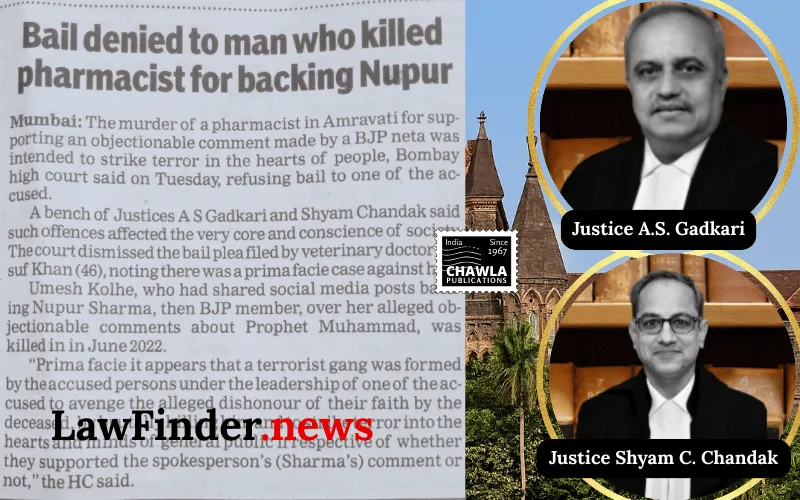
Court finds prima facie evidence of Khan's involvement in the conspiracy to murder Umesh Kolhe; bail denied under stringent UAPA provisions.
In a significant ruling, the Bombay High Court has denied bail to Yusuf Khan, the accused in a high-profile case involving the murder of Umesh Kolhe, a veterinary medical shop owner, which was linked to a larger conspiracy under the Unlawful Activities (Prevention) Act (UAPA). The bench, comprising Justices A.S. Gadkari and Shyam C. Chandak, found prima facie evidence establishing Khan's complicity in the conspiracy, which included circulating instigating messages and participating in meetings aimed at targeting the deceased.
The case traces back to a controversial comment made by an ex-spokesperson of a political party, which led to widespread outrage and unrest in the Muslim community in Amravati. Following the comment, tensions escalated, leading to the formation of a conspiracy to murder Kolhe, who had expressed support for the controversial comment on social media. The prosecution alleged that Khan, a veterinary doctor and member of a WhatsApp group where Kolhe had posted the message, crafted and circulated an inflammatory message that incited others against Kolhe, marking him for revenge.
The court noted that Khan's actions demonstrated a clear intent to avenge Kolhe's social media post, and his communication with co-accused further corroborated his involvement in the conspiracy. Despite arguments from Khan's counsel, Dr. Yug Mohit Chaudhry, who contended that Khan's actions were merely intended to affect Kolhe's business, the court upheld the prosecution's stance that the evidence presented a prima facie case of a serious offence impacting societal order and security.
The court emphasized the need for a holistic view of the materials presented, without detailed evaluation at the bail stage, as required under the UAPA's stringent bail provisions. The judgment highlighted that conspiracy could be inferred from circumstantial evidence and did not necessitate direct evidence, further establishing Khan's involvement in the criminal act.
The bench also referred to prior Supreme Court decisions underscoring that bail-restricting clauses under UAPA cannot be circumvented unless the materials presented are of low probative value, which was not the case here. The decision serves as a stern reminder of the rigorous standards applied in cases involving national security and terrorism-related offences.
The denial of bail comes as part of the court's broader approach to maintaining societal order and ensuring that those involved in heinous crimes face the full force of the law. The court's ruling underscores the gravity of the offences under UAPA and sets a precedent for similar cases in the future.
Bottom Line:
Bail application under UAPA - Accused's involvement in conspiracy to commit a terrorist act - Prima facie evidence supports the complicity of the accused in the crime, and such offences impact societal order and security.
Statutory provision(s): Unlawful Activities (Prevention) Act, 1967 Sections 16, 18, 20; Indian Penal Code Sections 109, 120B, 302, 153-A, 201, 505; Evidence Act, 1872 Section 14; Criminal Procedure Code, 1973 Section 439.
Yusuf Khan v. State of Maharashtra, (Bombay)(DB) : Law Finder Doc Id # 2841365