In a significant ruling, the court recognized irretrievable breakdown as a component of cruelty under the Special Marriage Act, 1954.
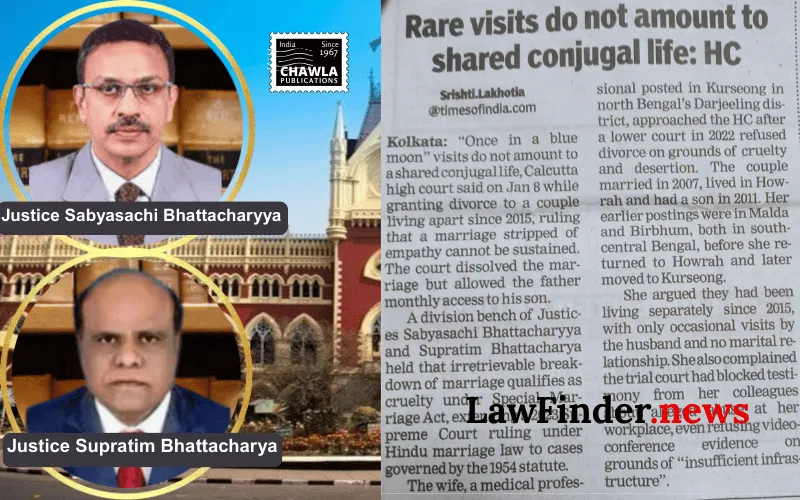
In a landmark judgment, the Calcutta High Court has granted a divorce to Dr. Soma Mandal Debnath from Sri Tanmoy Debnath, recognizing the irretrievable breakdown of their marriage as a component of cruelty under the Special Marriage Act, 1954. The decision was delivered by a division bench comprising Justices Sabyasachi Bhattacharyya and Supratim Bhattacharya, overturning a previous trial court decision that had dismissed the divorce petition.
Dr. Soma Mandal Debnath had filed for divorce on grounds of cruelty and desertion, alleging mental torture by her husband and his family, financial exploitation, and false pretenses regarding her husband's occupation. She claimed that her husband deserted her in 2015, and they have been living separately since then. The trial court had dismissed her suit for lack of evidence, but the High Court found that the appellant sufficiently proved her allegations.
The High Court noted that the doctrine of non-traverse applied, as the respondent's denials were evasive and lacked specific counter-evidence. The judgment emphasized that in civil proceedings, the standard of proof is based on a preponderance of probabilities rather than beyond a reasonable doubt, as in criminal cases.
The court also addressed the issue of irretrievable breakdown of marriage. Although not a standalone ground for divorce under Indian law, the court cited the Supreme Court's ruling in Rakesh Raman v. Kavita, which recognized irretrievable breakdown as a component of cruelty. The court observed that the marriage had reached a cul-de-sac, with no prospects of reconciliation, and maintaining such a façade would only inflict further cruelty on both parties.
In addition to granting the divorce, the court awarded visitation rights to Sri Tanmoy Debnath, allowing him to meet his minor son once a month, ensuring the welfare of the child while respecting the sentiments of all involved. The court urged both parties to act sensitively for the child's benefit.
This judgment underscores the evolving interpretation of matrimonial laws in India, where the judiciary is increasingly recognizing the complexities of marital relationships and the necessity for legal frameworks to adapt to contemporary societal realities.
Bottom Line:
The marriage between the parties was dissolved based on grounds of cruelty and desertion, with irretrievable breakdown of the marriage being considered as a component of cruelty under the Special Marriage Act, 1954.
Statutory provision(s): Special Marriage Act, 1954 Section 27
Dr. Soma Mandal Debnath v. Sri Tanmoy Debnath, (Calcutta)(DB) : Law Finder Doc Id # 2834638