Court Affirms Election Offences Must Be Addressed Through Statutory Provisions, Not Arbitrary Directions
In a significant ruling, the Calcutta High Court has stayed the Election Commission of India's (ECI) blanket directions that labeled certain citizens as "trouble-makers" and directed police action against them. This directive, issued by the Chief Electoral Officer of West Bengal, had enlisted approximately 800 individuals, including elected officials, for allegedly intimidating voters and disturbing the electoral process.
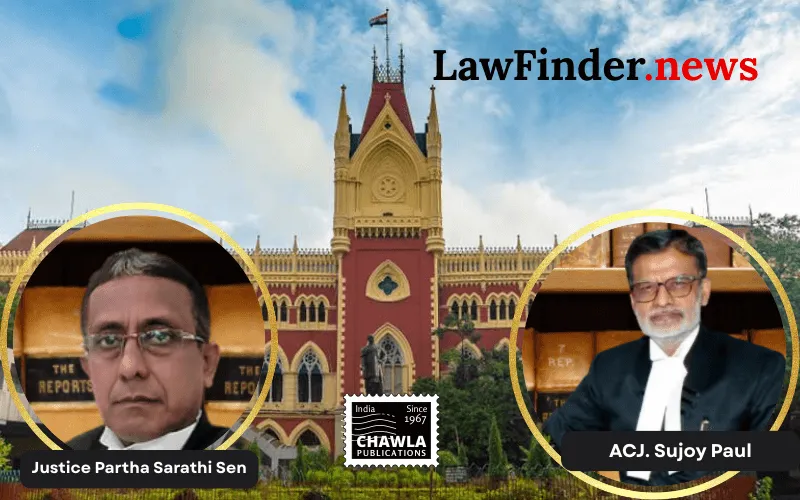
The Division Bench, comprising Chief Justice Sujoy Paul and Justice Partha Sarathi Sen, emphasized that the Election Commission does not possess unbridled powers under Article 324 of the Constitution of India to issue such directives. The Court underscored that election-related offences are to be dealt with strictly in accordance with the Representation of Peoples Act, 1951, and the Bharatiya Nagarik Suraksha Sanhita, 2023.
The petitioner, Md. Danish Farooqui, represented by Senior Advocate Mr. Kalyan Bandyopadhyay, argued that the impugned order violated the personal liberty of citizens as guaranteed under Article 21 of the Constitution. It was contended that the ECI's use of the term "trouble-makers" was arbitrary and not grounded in any statutory definition or law.
The Court further noted that the ECI's powers are not absolute and must operate within the framework of existing laws. It highlighted that any preventive action or detention must comply with the relevant legal procedures, echoing the principles laid down in previous Supreme Court judgments, including the case of "Satender Kumar Antil v. Central Bureau of Investigation".
In its interim order, the Court has stayed the execution of the ECI's directive until the end of June 2026 or further orders. However, it clarified that this stay does not prevent law enforcement from taking action against individuals who genuinely commit offences under the applicable electoral or penal laws.
The ruling reaffirms the judiciary's stance on upholding the rule of law and ensuring that statutory procedures govern the exercise of power by authorities. It also serves as a reminder that the freedom of citizens cannot be curtailed through arbitrary executive actions.
Bottom Line:
Election Commission cannot issue blanket directions against citizens under Article 324 of the Constitution when election-related offences are statutorily covered under specific laws such as the Representation of Peoples Act, 1951 and Bharatiya Nagarik Suraksha Sanhita, 2023. Action against individuals must be taken strictly in accordance with prescribed legal procedures.
Statutory provision(s): Articles 21, 22, 324 of the Constitution of India, Representation of Peoples Act, 1951, Bharatiya Nagarik Suraksha Sanhita, 2023, Sections 129 to 135A of the Representation of Peoples Act, 1951, Section 35 of Bharatiya Nagarik Suraksha Sanhita, 2023
MD. Danish Farooqui v. Election Commission of India, (Calcutta)(DB) : Law Finder Doc id # 2887135