The court ruled that encroachers occupying pathways do not qualify for protections under the Public Premises (Eviction of Unauthorized Occupants) Act, 1971.
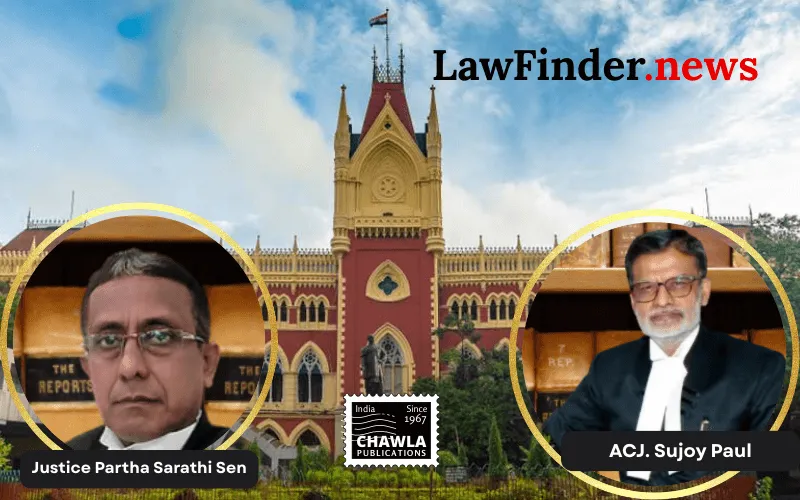
In a significant ruling, the Calcutta High Court dismissed an intra-Court appeal in the case of Chandeswhwar Shaw v. State of West Bengal, affirming the eviction of unauthorized occupants from a pathway belonging to the Syama Prasad Mookerjee Port, Kolkata. The Division Bench comprising Chief Justice Sujoy Paul and Justice Partha Sarathi Sen upheld the decision of the Single Bench, which had permitted police assistance for the removal of encroachers from the approach road leading to a proposed multispecialty hospital.
The appellants, who claimed to have occupied the land for over 35 years, contended that they were unlawfully evicted without due process and without being made parties to the original writ petition. They argued that their eviction should have been carried out under the provisions of the Public Premises (Eviction of Unauthorized Occupants) Act, 1971, which mandates due process for evicting unauthorized occupants of public premises.
However, the court observed that the definition of "public premises" under the Act does not include pathways or approach roads. The court held that the appellants, being encroachers of a pathway, do not fall under the protections accorded to unauthorized occupants of public premises under the Act. Consequently, the Estate Officer of the Port Authority was not obligated to follow the eviction procedures prescribed by the Act for removing the encroachers.
The judgment clarified the distinction between unlawful occupants of public premises and encroachers of pathways, emphasizing that the appellants failed to prove any jural relationship with the Port Authority or establish lawful possession of any public premises. The court noted that the appellants were residents of 'Madhu Busty' and did not provide any evidence to substantiate their claim of settled possession over the land in question.
The court also dismissed the appellants' reliance on various Supreme Court judgments, stating that the cited cases were distinguishable from the facts of the present case. The court reiterated that even trespassers cannot be evicted forcibly without due process, but the provisions of the Public Premises Act did not apply to the appellants as their occupation did not qualify as occupation of "public premises."
The Calcutta High Court's decision underscores the importance of adhering to statutory definitions and procedures in eviction cases, while also highlighting the limitations of legal protections for encroachers of pathways. This ruling is expected to have implications for similar cases involving encroachments on public pathways and approach roads across the country.
Bottom Line:
Unauthorized occupation of public premises - An unauthorized occupant cannot be evicted forcibly without following the due process of law as per the Public Premises (Eviction of Unauthorized Occupants) Act, 1971 - However, encroachers of a pathway do not fall under the definition of 'public premises' under Section 2(c) of the said Act, and therefore, eviction can be carried out without invoking the provisions of the said Act.
Statutory provision(s): Public Premises (Eviction of Unauthorized Occupants) Act, 1971 Sections 2(c), 2(e), 2(g), 4, 5, 5A, 5B; Limitation Act, 1963 Section 27, Article 64.
Chandeswhwar Shaw v. State of West Bengal, (Calcutta)(DB) : Law Finder Doc id # 2849249