The court confirms eligibility under DoPT Office Memorandum, dismissing Union of India's challenge against the Central Administrative Tribunal's decision.
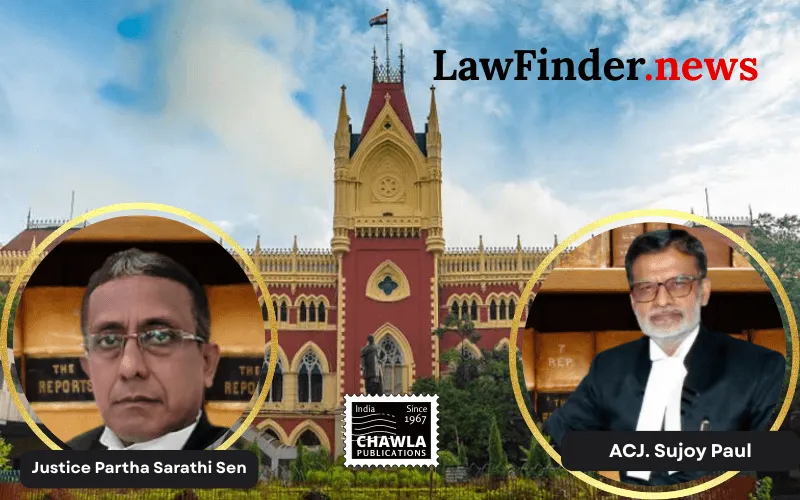
In a significant ruling, the Calcutta High Court dismissed a writ petition filed by the Union of India challenging the Central Administrative Tribunal's order, which granted family pension to Mita Saha Karmakar, a divorced daughter of a deceased pensioner. The division bench, comprising Acting Chief Justice Sujoy Paul and Justice Partha Sarathi Sen, upheld the tribunal's interpretation of the Department of Personnel and Training (DoPT) Office Memorandum dated July 19, 2017, confirming the pension eligibility of divorced daughters who were dependent on their deceased parents.
The case revolved around the claim of Mita Saha Karmakar, whose divorce was finalized after the death of her father, a former South Eastern Railway employee. The tribunal had earlier ordered the authorities to grant her family pension, citing her dependency on her father after being deserted by her husband in 1995, while divorce proceedings were initiated during the lifetime of her father.
The Union of India contended that the divorce decree was granted after the death of her parents, arguing against her dependency status at the time of her father’s death. However, the court found ample evidence that Mita was forced to return to her paternal home in 1997 due to her husband's desertion, highlighting her dependency status.
The court emphasized that the DoPT's memorandum does not require the divorce to be finalized during the parents' lifetime, as long as the proceedings were initiated while they were alive, aligning with the memorandum's objective to support dependent family members financially.
Referring to past judgments, including Union of India v. Jayanti Chatterjee, the court distinguished this case, noting that Mita had successfully demonstrated her dependency and the initiation of divorce proceedings during her father's lifetime. The court concluded that the tribunal's decision was well-reasoned and without any illegality, warranting no interference.
The ruling underscores the judiciary's recognition of the nuanced realities faced by dependent family members and affirms the legal protections available under the Central Civil Services (Pension) Rules, 1972, and relevant government directives.
Bottom Line:
Family Pension - Eligibility of divorced daughter - Dependency on deceased pensioner father established based on factual evidence and interpretation of the relevant Department of Personnel and Training (DoPT) Office Memorandum (OM) dated 19.07.2017 - Tribunal's order upheld as it correctly interpreted and applied the OM.
Statutory provision(s): Central Civil Services (Pension) Rules, 1972 - Rule 54, DoPT OM dated 19.07.2017
Union of India v. Mita Saha Karmakar, (Calcutta)(DB) : Law Finder Doc Id # 2819885