Court reaffirms that the right to protest under Article 19 is subject to reasonable restrictions, dismissing appeal for demonstration at Nabanna
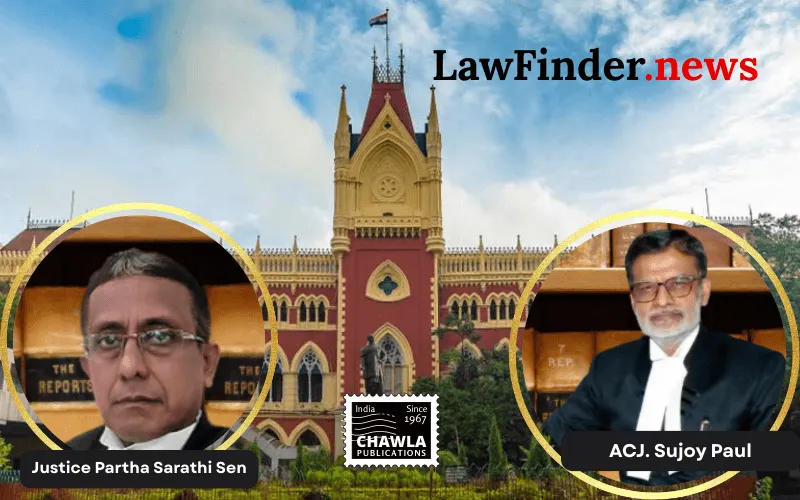
In a significant judgment delivered on January 29, 2026, the Calcutta High Court upheld the state's authority to regulate the venue and timing of public protests, emphasizing that the right to protest is not an absolute right under Article 19 of the Constitution of India. The Division Bench, comprising Chief Justice Sujoy Paul and Justice Partha Sarathi Sen, dismissed the appeal filed by Sankar Ghosh, an elected member of the Legislative Assembly, challenging the rejection of his application to hold a demonstration in front of Nabanna, the headquarters of the State Government.
The appellant, Sankar Ghosh, had sought permission for a peaceful sit-in demonstration involving 50 members of the Legislative Assembly. However, the police administration denied the application citing concerns for public order and safety. The Single Judge had previously allowed the protest at an alternative venue, Mandirtala Bus Stand, with specified conditions, which the appellant contested in the intra-court appeal.
The court, while delivering its judgment, reiterated that the right to protest is subject to reasonable restrictions imposed by the state. It drew upon precedents set by the Supreme Court in cases such as Himmat Lal K. Shah v. Commissioner of Police, Shaheen Bagh, and Ramlila Maidan Incident, underscoring that freedom of assembly must be balanced with public order and cannot infringe upon the rights of others.
The judgment also addressed the applicability of prohibitory orders under Section 163 of the Bharatiya Nagarik Suraksha Sanhita, 2023, highlighting that such orders are temporary and can be issued in emergent circumstances to prevent an imminent breach of peace. The court observed that the state's decision to regulate the venue and timing of the protest did not violate the appellant's constitutional rights and upheld the reasonable restrictions imposed.
In his arguments, the appellant's counsel contended that the rejection was inconsistent with previous permissions granted for similar demonstrations at Nabanna. However, the court noted the absence of a challenge to the prohibitory order and emphasized that the state's decision was backed by valid law and reasonable conditions.
The judgment marks a reaffirmation of the balance between individual liberties and lawful regulation, ensuring that protests do not disrupt public order. The decision is expected to influence future cases concerning the regulation of public demonstrations in the state.
Bottom Line:
Right to protest is not an absolute right under Article 19 of the Constitution and is subject to reasonable restrictions. The State is empowered to regulate protests concerning time and place, and stringent restrictions must pass the test of reasonableness.
Statutory provision(s): Article 19 of the Constitution, Section 163 of Bharatiya Nagarik Suraksha Sanhita, 2023
Sankar Ghosh v. State of West Bengal, (Calcutta)(DB) : Law Finder Doc id # 2845367