Court Denounces Practice of Changing Counsel for Review Petitions and Reiterates Limited Scope of Review Jurisdiction
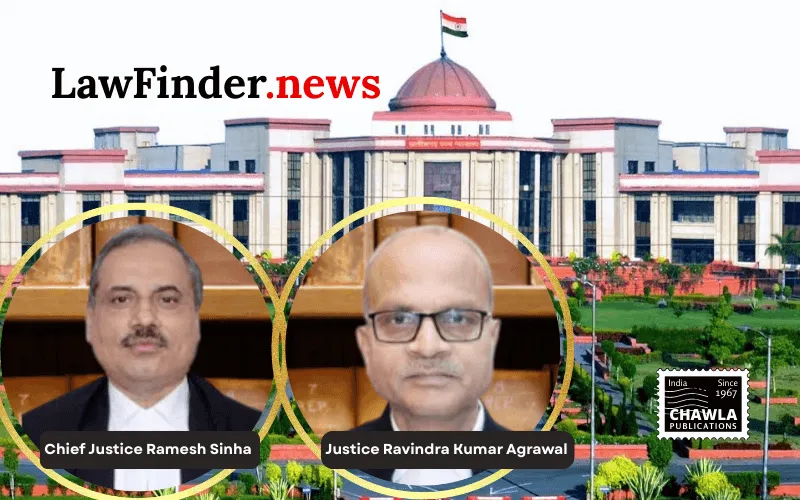
Raipur, December 15, 2025 - The Chhattisgarh High Court has dismissed a review petition filed by Sanjeev Kumar Yadav, imposing a cost of Rs. 50,000 on the petitioner for filing a misconceived review petition after the dismissal of his appeal by the Supreme Court. The Division Bench of Chief Justice Ramesh Sinha and Justice Ravindra Kumar Agrawal ruled that the petition was an improper attempt to reargue the case on merits, highlighting the misuse of legal procedures when a different counsel was engaged without a "No Objection Certificate" from the previous advocate.
The petitioner had initially challenged the orders from the Commissioner of Surguja Division and Zila Panchayat, Jashpur, which penalized him by stopping four annual increments due to a departmental inquiry. His petition and subsequent appeal were dismissed by the Single Judge and Division Bench respectively, on the grounds that the inquiry was conducted fairly and without violation of natural justice.
In his review petition, Yadav argued that the inquiry report was not provided before the penalty order, a claim found to be baseless by the court. The court emphasized that a review petition cannot serve as a disguised appeal and that the scope of review is limited to correcting patent errors, not for rehearing on merits.
The court criticized the practice of filing review petitions with different counsel, as seen in this case where Mr. Rohitashva Singh was engaged for the review petition without obtaining consent from the original counsel, Mr. Vineet Kumar Pandey. This practice was condemned as unhealthy for the profession and is discouraged by the Supreme Court's precedents.
Despite the Supreme Court's dismissal of the Special Leave Petition (SLP) in limine, the petitioner sought review on grounds that were not raised before the Supreme Court. The High Court reiterated that substantial grounds must be demonstrated for a review petition to be maintainable, which was not achieved in this instance.
The court further referenced several Supreme Court judgments underscoring the limited purpose of review jurisdiction, including "Tungabhadra Industries Limited v. Government of Andhra Pradesh" and "Kamlesh Verma v. Mayawati," which affirm that review cannot be used to reargue a case but only to address clear errors.
In light of the frivolous nature of the review petition and the change of counsel, the court decided to impose a cost, reduced to Rs. 50,000 after the petitioner's counsel apologized for the misuse of legal process. The amount is to be paid to a Government Specialized Adoption Agency within one month, failing which recovery will be enforced as arrears of land revenue.
The judgment serves as a caution against engaging in practices that waste judicial time and resources, reinforcing the need for adherence to procedural correctness and respect for the judiciary’s time.
Bottom Line:
Review petition cannot be entertained to reargue the matter on merits when no error apparent on the face of the record is demonstrated, and the same counsel who argued the original matter should ideally file the review petition.
Statutory provision(s): Order 47, Rule 1 of the Code of Civil Procedure, Tamil Nadu Electricity Board v. N. Raju Reddiar, Khoday Distilleries Limited v. Sri Mahadeshwara Sahakara Sakkare Karkhane Limited, Tungabhadra Industries Limited v. The Government of Andhra Pradesh, Kamlesh Verma v. Mayawati.
Sanjeev Kumar Yadav v. State Of Chhattisgarh, (Chhattisgarh)(DB) : Law Finder Doc Id # 2823444