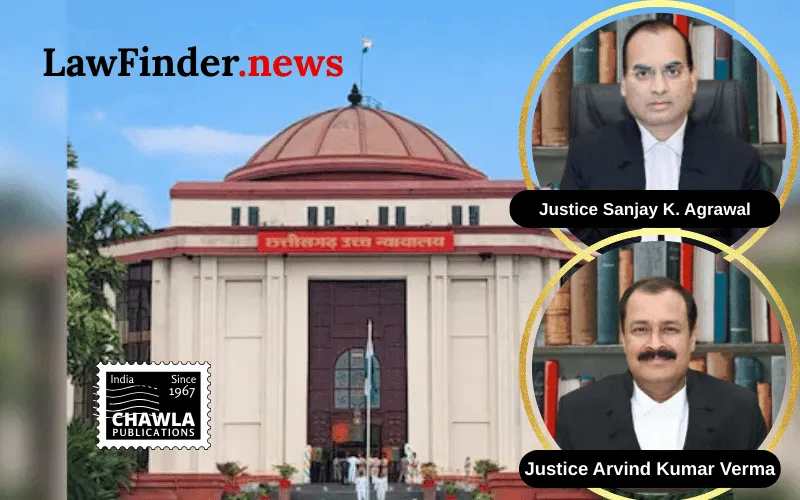
High Court affirms that Scheduled Tribe members who follow Hindu customs are subject to Hindu Marriage Act provisions.
In a significant ruling, the Chhattisgarh High Court has set aside a judgment by the Family Court in Bastar, Jagdalpur, which had rejected a divorce application filed under Section 13B of the Hindu Marriage Act, 1955, by a tribal husband and a non-tribal wife. The High Court held that the couple, who were married according to Hindu customs, are subject to the provisions of the Hindu Marriage Act and not exempted under Section 2(2) of the same Act.
The case involved appellants Smt. Gudiya Nagesh and her husband, who belong to Scheduled Caste and Scheduled Tribe respectively. Their marriage, conducted as per Hindu customs including the performance of 'saptpadi', was initially deemed outside the purview of the Hindu Marriage Act by the Family Court on the grounds that the Act does not apply to Scheduled Tribes, as per Section 2(2).
However, the High Court, presided over by Justices Sanjay K. Agrawal and Arvind Kumar Verma, concluded that the exclusion under Section 2(2) is intended to protect tribal customs rather than exclude all Scheduled Tribe members from codified Hindu law. The court emphasized that once members of Scheduled Tribes adopt Hindu customs, they become subject to the Hindu Marriage Act. The judgment referenced past Supreme Court and High Court rulings, reinforcing that 'Hinduised' tribal individuals should not be relegated to customary courts.
The High Court's ruling mandates a reconsideration of the divorce application on its merits, aligning with the appellants' argument that their adherence to Hindu customs qualifies them for legal processes under the Hindu Marriage Act. This decision highlights the complexity of personal law application in a culturally diverse society and underscores the legal recognition of evolving cultural practices.
Bottom Line:
Hindu Marriage Act, 1955 applicability - Members of Scheduled Tribes who have adopted Hindu customs and traditions are governed by Hindu law and can invoke provisions of the Act.
Statutory provision(s): Hindu Marriage Act, 1955 Sections 2(2), 13B; Family Courts Act, 1984 Section 19(1)
Smt. Gudiya Nagesh, (Chhattisgarh)(DB) : Law Finder Doc id # 2861317