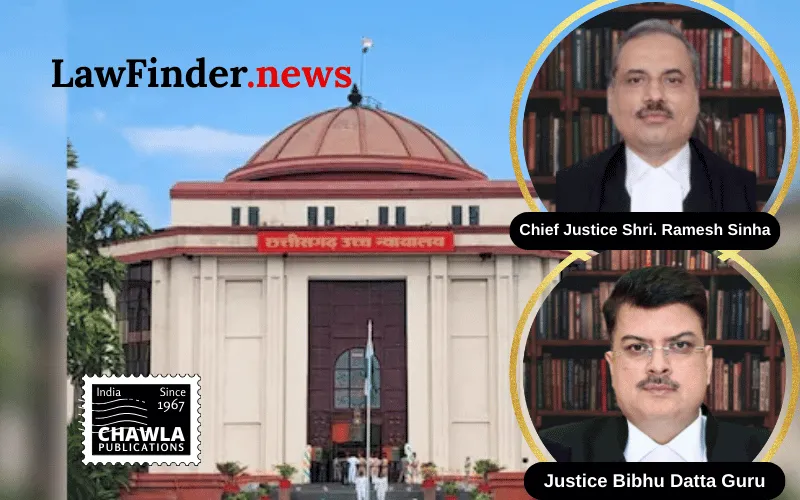
Court Holds Demand Notice for Rs. 153.55 Crores Null and Void Without Hearing, Directs Fresh Adjudication by State Electricity Regulatory Commission
In a significant judgment delivered on June 2, 2026, the Chhattisgarh High Court (Division Bench) quashed the demand notice issued by Chhattisgarh State Power Distribution Company Limited (CSPDCL) seeking refund of Rs. 153.55 crores from Jindal Steel Limited (formerly Jindal Steel and Power Limited), highlighting a breach of natural justice principles. The Court observed that the appellant generating company was not afforded an opportunity of hearing in the tariff determination, review, or appellate proceedings, which formed the basis of the demand.
The dispute arose from power purchase agreements (PPAs) executed between Jindal Steel Limited and CSPDCL for supply of electricity during financial years 2011-12 and 2012-13. The CSPDCL raised a retrospective demand for refund alleging excess tariff payment based on findings of the Chhattisgarh State Electricity Regulatory Commission (CSERC) and the Appellate Tribunal for Electricity, which had held the power supplied to be "non-firm" and therefore eligible for a lower tariff.
Jindal Steel challenged the demand notice, contending that the tariff orders and appellate decisions were passed without impleading the company as a party, thereby violating the audi alteram partem principle. The company further submitted that the PPAs were binding contracts and payments were made without protest, and no provision existed for refund of amounts already settled. It was also argued that the denial of No Objection Certificate (NoC) for open access based on disputed dues was unsustainable.
The High Court, after detailed examination, agreed with Jindal Steel's contentions. It held that mere publication of public notices or the presence of a company representative in review hearings did not substitute for adequate notice and opportunity to be heard in quasi-judicial proceedings that directly affect contractual rights and financial liabilities. The Court reiterated that any order passed in violation of natural justice is void ab initio and cannot be ratified by subsequent conduct.
Further, the Court clarified that Section 62(6) of the Electricity Act, 2003, which allows recovery of excess tariff, does not dispense with the requirement of proper adjudication with notice and hearing to the affected party. The Court emphasized that regulatory disallowance against a distribution licensee does not ipso facto create a recovery claim against the generating company without independent proceedings.
The Court also found that the denial of NoC and open access on the basis of disputed dues without adjudication was unlawful, infringing the appellant's right to trade under Article 19(1)(g) of the Constitution. The judgment noted that the tariff determination and true-up proceedings assumed a quasi-judicial character vis-à-vis Jindal Steel, necessitating adherence to the principles of natural justice.
Setting aside the order of the Single Judge which had dismissed Jindal Steel's writ petition, the Division Bench directed the State Commission to afford the company a full opportunity of hearing and decide the matter afresh within two months. It also stayed the operation of the demand notice and related communications until fresh adjudication.
This ruling underscores the judiciary’s commitment to uphold the sanctity of contractual rights and the fundamental principles of natural justice in regulatory adjudications, particularly in the power sector where tariff and procurement disputes can have substantial financial implications.
Bottom Line:
Electricity Tariff - Violation of principles of natural justice - Demand notice issued against a generating company without providing an opportunity of being heard is a nullity in law.
Statutory provision(s): Electricity Act, 2003 Sections 32, 45, 62, 64, 86, 120, 125; Chhattisgarh State Electricity Regulatory Commission (Conduct of Business) Regulations, 2009; Limitation Act, 1963