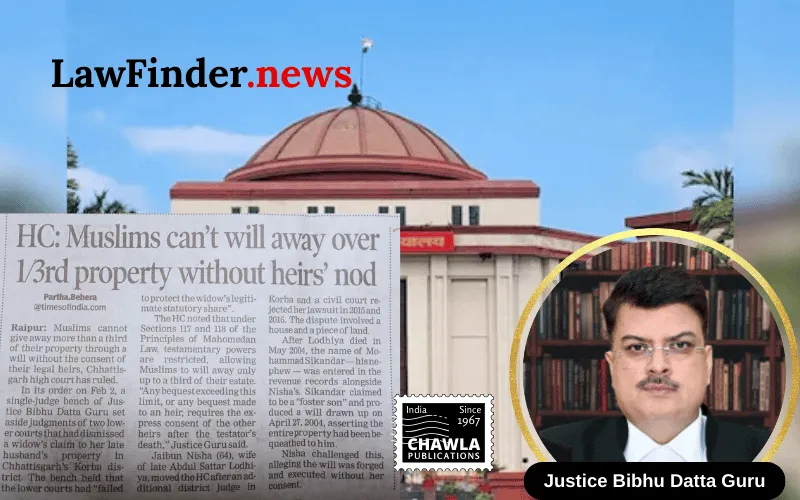
In a landmark judgment, the High Court reaffirms restrictions on testamentary dispositions under Mahomedan Law, ensuring equitable distribution among heirs.
In a significant ruling, the Chhattisgarh High Court has overturned the judgments of the lower courts in the case of Smt. Jaibun Nisha v. Mohd. Sikandar, reinforcing the principles of testamentary disposition under Mahomedan Law. The judgment, delivered by Justice Bibhu Datta Guru, underscores the limitations imposed on testamentary powers by Sections 117 and 118 of Mahomedan Law, which restrict a Mahomedan from bequeathing more than one-third of their estate without the consent of other heirs.
The case revolved around a disputed Will allegedly executed by Abdul Sattar Lodhiya, which purportedly bequeathed his entire property to Mohd. Sikandar, the respondent, who was claimed to be a foster son. The appellant, Smt. Jaibun Nisha, the widow of Abdul Sattar, contested the validity of the Will, asserting that it violated Mahomedan Law as she had not consented to the disposition of the estate exceeding one-third.
The High Court, upon examining the evidence and the legal provisions, concluded that the burden of proof regarding the consent of heirs post-death was wrongly shifted to the appellant by the lower courts. Justice Guru emphasized that under Mahomedan Law, a Will disposing of more than one-third of an estate is invalid unless the heirs consent to it after the testator's death. The Court noted that the respondent failed to establish that such consent was obtained, thereby rendering the Will unenforceable beyond the permissible one-third limit.
In delivering the judgment, the Court cited precedent cases and interpretations of Mahomedan Law, reinforcing the principle that any bequest to an heir requires explicit consent from other heirs after the testator's demise. The Court criticized the lower courts for dismissing the appellant's suit entirely, stating that her status as a legal heir entitled her to a share of the estate in accordance with the law.
The judgment is a pivotal reaffirmation of personal law principles, ensuring that statutory provisions are adhered to and preventing unjust enrichment at the expense of lawful heirs. The High Court's decision mandates that the estate be distributed lawfully, with the appellant receiving her rightful share as per the testamentary restrictions.
This ruling not only underscores the importance of adhering to personal law in testamentary matters but also sets a precedent for future cases involving similar disputes under Mahomedan Law, highlighting the judiciary's role in protecting legal rights and ensuring equitable distribution among heirs.
Bottom Line:
Under Mahomedan Law, a bequest to an heir is not valid unless the other heirs consent to the bequest after the death of the testator. Moreover, a Mahomedan cannot dispose of more than one-third of his estate by Will without such consent.
Statutory provision(s): Sections 117, 118 of Mahomedan Law, Section 100 of Civil Procedure Code, 1908
Smt. Jaibun Nisha v. Mohd. Sikandar, (Chhattisgarh) : Law Finder Doc id # 2848386