Father's financial advantage outweighed by concerns over second marriage and child's emotional well-being, rules court.
In a significant judgment, the Chhattisgarh High Court has reinforced the principle that the welfare of a minor child remains paramount in custody disputes. The court dismissed an appeal by Laxmikant Joshi, who sought custody of his minor son, Yash Joshi, emphasizing that financial capability alone does not determine a parent’s eligibility for custody.
The case arose when Laxmikant, the appellant, challenged a decision by the Family Court, Bemetara, which denied him custody of his seven-year-old son. The Family Court's decision had been based on allegations that Laxmikant was living with a second wife without obtaining a divorce from his first wife, the respondent in the case, Lokeshwari @ Parmeshwari.
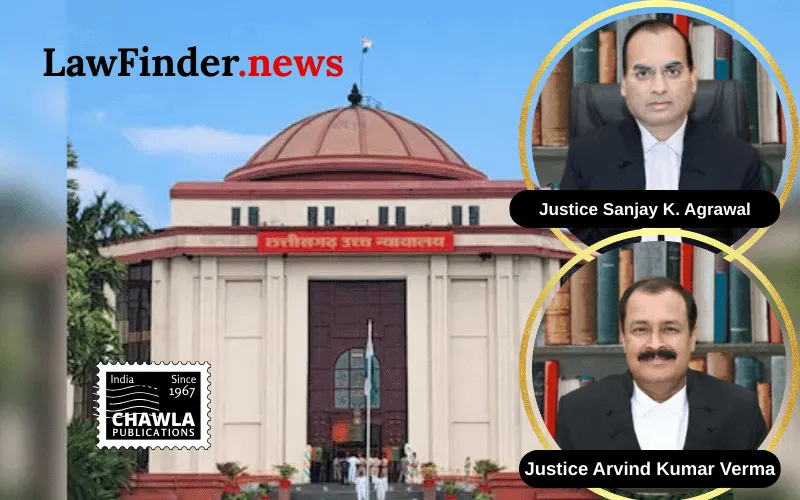
The bench, comprising Justices Sanjay K. Agrawal and Arvind Kumar Verma, highlighted that under the Hindu Minority and Guardianship Act, 1956, the child's welfare is the paramount consideration in such cases. The court found that although Laxmikant was financially capable, his personal conduct and living arrangements were not conducive to the welfare of the minor.
The court drew attention to Section 13 of the Hindu Minority and Guardianship Act, which mandates that the child’s welfare is the primary consideration for custody decisions. It was noted that emotional, physical, and moral welfare should all be considered, not just financial stability.
The judgment also referenced several precedents from the Supreme Court, which have consistently held that the child’s welfare takes precedence over the rights of parents. The court observed that placing the child in a potentially unstable environment, with a father engaged in a second marriage, would not be in the child’s best interests.
The Family Court had exercised its parens patriae jurisdiction, a legal doctrine that grants the court authority to act as a guardian for those who are unable to care for themselves, to reject Laxmikant's application. The High Court upheld this exercise of jurisdiction, reinforcing that the father’s misconduct and the stability provided by the mother were crucial factors in the decision.
The court further observed that while financial stability is an important aspect, it cannot override the need for a stable and loving environment, which the mother provided. The judgment underscores that the presence of a second wife in the father’s household could potentially disrupt the child’s emotional well-being.
In conclusion, the High Court affirmed the Family Court's decision, maintaining that the child’s welfare was best served under the care of the mother. This ruling serves as a reminder of the judiciary's commitment to prioritizing the best interests of children in custody disputes, beyond mere financial considerations.
Bottom Line:
Custody of a minor - Welfare of the child is paramount consideration - Financial superiority of a parent cannot solely determine custody, especially when the welfare of the child is at stake.
Statutory provision(s): Hindu Minority and Guardianship Act, 1956, Sections 6, 13
Laxmikant Joshi v. Lokeshwari @ Parmeshwari, (Chhattisgarh)(DB) : Law Finder Doc id # 2839729