Supreme Court Upholds Criminal Proceedings Against Rocky in Contractual Dispute Case Apex Court Dismisses Appeal Against Telangana High Court's Decision, Emphasizes Limited Scope of Quashing Under Section 482 CrPC
In a significant ruling, the Supreme Court of India has dismissed an appeal filed by appellant Rocky, challenging the Telangana High Court's decision to maintain criminal proceedings against him. The case, stemming from a contractual dispute involving construction work, highlights the judiciary's cautious approach in exercising the power to quash criminal proceedings under Section 482 of the Code of Criminal Procedure (CrPC).
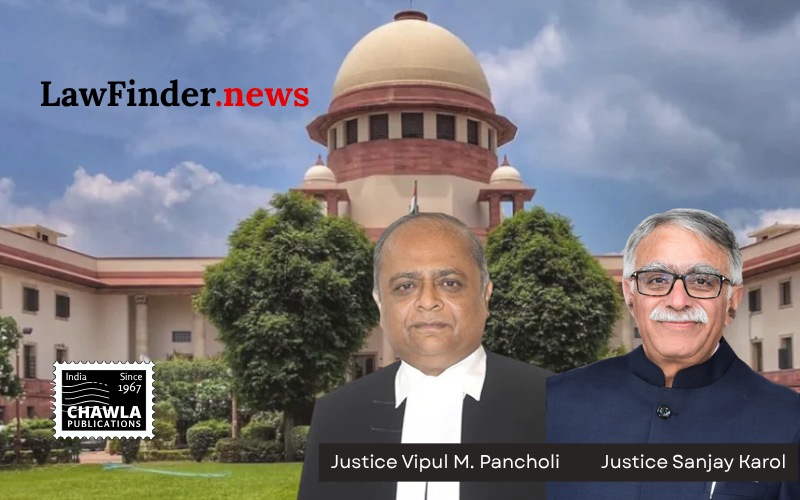
The bench, comprising Justices Sanjay Karol and Vipul M. Pancholi, delivered the judgment on December 4, 2025, in the case titled "Rocky v. State of Telangana." The apex court reaffirmed the High Court's decision to uphold cognizance under Sections 420 (cheating), 344 (wrongful confinement), and 506 (criminal intimidation) of the Indian Penal Code (IPC), while quashing charges under Section 406 (criminal breach of trust).
The legal tussle dates back to a construction project undertaken between 2008 and 2010, with allegations that Rocky induced Respondent No. 2 to complete substantial work but withheld payments. Despite a No-Dues Certificate purportedly issued by Respondent No. 2, disputes persisted, culminating in the lodging of FIR No. 240 of 2015. The charge sheet was filed in 2016, leading to the ongoing criminal proceedings.
Rocky's counsel contended that the dispute was civil in nature and improperly given a criminal dimension. They argued that the proceedings were a counterblast to an injunction order and suffered from an unexplained delay. However, the court emphasized the coexistence of civil and criminal remedies, asserting that valid criminal liability should not be negated by the existence of civil proceedings.
The court underscored the necessity of adhering to established legal standards for quashing criminal proceedings, referencing landmark judgments like "State of Haryana v. Bhajan Lal" and "Pradeep Kumar Kesarwani v. State of Uttar Pradesh." It reiterated that quashing is warranted only in exceptional circumstances where the allegations are inherently improbable or patently absurd.
Dismissing the appeal, the Supreme Court highlighted the absence of manifest illegality or arbitrariness in the High Court's decision. The bench concluded that the allegations against Rocky disclosed prima facie elements of the offenses under Sections 420, 344, and 506 of the IPC, warranting the continuation of criminal proceedings.
This judgment serves as a reminder of the judiciary's restrained approach in quashing proceedings and reinforces the legal principle that criminal law cannot be misused to settle civil or commercial disputes.
Statutory provisions: Section 482 of CrPC, Sections 420, 344, 506 of IPC
Rocky v. State of Telangana, (SC) : Law Finder Doc id # 2818074