Supreme Court Modifies Consumer Commission's Compensation Award to Rs. 25 Lakh in ITC Salon Service Case, The Supreme Court criticizes reliance on unverified photocopies and reduces compensation from Rs. 2 crore to the amount already deposited by ITC.
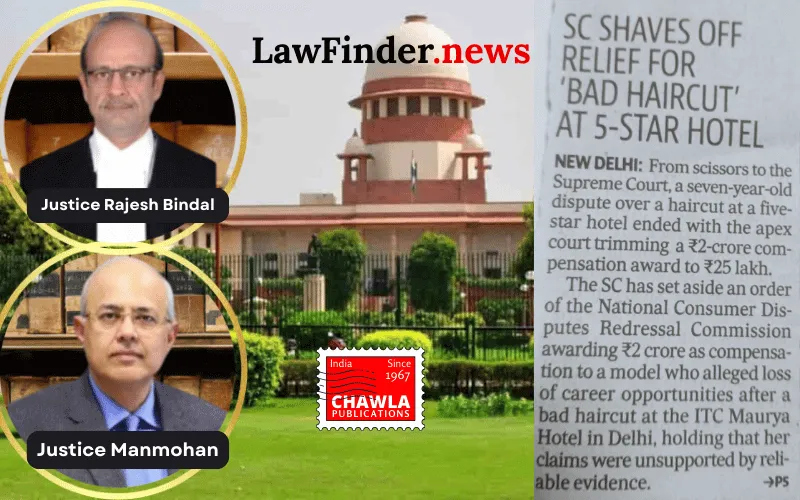
In a significant ruling, the Supreme Court of India has modified the compensation awarded by the National Consumer Disputes Redressal Commission (NCDRC) in the case involving ITC Limited and Aashna Roy. The apex court reduced the compensation from Rs. 2 crore to Rs. 25 lakh, which had already been deposited by ITC and released to the respondent, Aashna Roy. The case stemmed from a complaint filed by Aashna Roy against ITC Limited for a dissatisfactory haircut service at the ITC Maurya Hotel in New Delhi back in April 2018.
The Supreme Court bench comprising Justices Rajesh Bindal and Manmohan delivered the judgment, emphasizing that compensation claims must be supported by credible and reliable evidence, especially when the amounts involved are substantial. The court found that the NCDRC had erred in awarding such a large compensation based solely on photocopies of documents provided by Roy, without any original documents or reliable evidence to substantiate her claims.
The court reiterated the importance of adhering to the principles of natural justice, stating that while the strict application of the Evidence Act is not required in consumer disputes, the production of original documents or adequate proof through permissible modes is necessary for fair adjudication. The judgment underscored that the NCDRC's approach of relying on insufficient and unverified evidence was flawed.
The Supreme Court noted that despite the opportunity to present original evidence, Aashna Roy had failed to substantiate her claims with credible documentation. The bench highlighted several discrepancies in the photocopies of the documents presented by Roy, which included job offers, modelling assignments, and medical certificates. The court pointed out that the evidence lacked authenticity and credibility, making it insufficient to justify the enormous compensation initially awarded.
The court's decision to uphold the compensation already released underscores the necessity for claimants to provide concrete evidence when seeking substantial damages. The judgment serves as a reminder of the judiciary's role in ensuring fair and just compensation based on reliable evidence, especially in consumer disputes where large sums are claimed.
Bottom Line:
Award of compensation based on deficiency in service - Compensation claims must be substantiated with reliable and trustworthy evidence, especially when they are significantly high.
Statutory provision(s): Consumer Protection Act, 1986 Section 22
ITC Limited v. Aashna Roy, (SC) : Law Finder Doc id # 2850152