Supreme Court Acquits Anjani Singh in 2004 Double Homicide Case Supreme Court finds insufficient evidence and unreliable eyewitness testimony in acquitting Anjani Singh in the 2004 Ballia shooting incident.
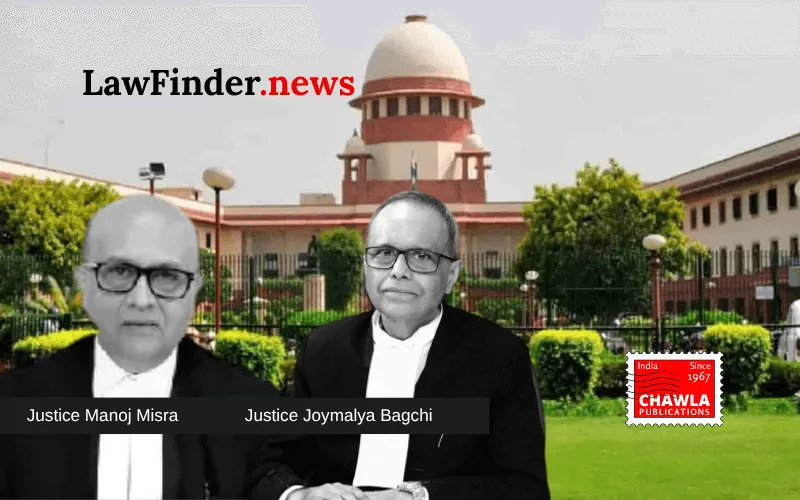
In a landmark judgment delivered on January 5, 2026, the Supreme Court of India acquitted Anjani Singh, the appellant in the 2004 Ballia shooting case, citing significant doubts due to insufficient evidence and unreliable eyewitness testimony. The Supreme Court bench, comprising Justices Manoj Misra and Joymalya Bagchi, overturned the convictions handed down by the Allahabad High Court, emphasizing the principles of reasonable doubt and the necessity of corroborative evidence in criminal trials.
The case stemmed from an incident on October 20, 2004, at a village in Ballia, Uttar Pradesh, where a celebratory drama play turned tragic as gunfire erupted, resulting in the deaths of Krishna Kant Verma and Banarasi, and injuries to several others. Anjani Singh, along with Ravindra Singh and Rishabh Dev Singh, were charged and convicted by the trial court under Sections 302, 307, and 504 of the Indian Penal Code (IPC). While Rishabh Dev Singh was acquitted by the High Court, Anjani Singh's conviction was upheld until the Supreme Court's recent ruling.
The prosecution's case heavily relied on the testimony of a solitary eyewitness, PW-1, whose account was marred by inconsistencies and a criminal history that raised questions about his credibility. The court noted that other injured witnesses failed to support the prosecution's case, asserting that the lights went out during the shooting, making it impossible to identify the shooters.
The Supreme Court highlighted several critical issues in the case, including the lack of forensic evidence linking the seized rifle to the crime, the absence of a clear motive to target the deceased, and the fact that the gunshot wounds suggested close-range firing, contradicting the prosecution's theory of indiscriminate shooting. The court also pointed out that the magazine recovered from the crime scene did not match the seized rifle, further complicating the prosecution's narrative.
Justice Misra, delivering the judgment, stressed that the prosecution failed to prove its case beyond a reasonable doubt. The court emphasized that the benefit of doubt should be extended to the accused when the evidence is not compelling enough to establish guilt conclusively. Consequently, the Supreme Court acquitted Anjani Singh, discharging his bail bonds and closing a contentious chapter in this long-standing legal saga.
Bottom Line:
Conviction based on testimony of a solitary eyewitness with criminal antecedents, inconsistent testimony, and lack of corroborative evidence raises significant doubts. Benefit of doubt should be extended when prosecution fails to prove its case beyond reasonable doubt.
Statutory provision(s): Sections 302, 307, 504 of the Indian Penal Code, 1860
Anjani Singh v. State of Uttar Pradesh, (SC) : Law Finder Doc Id # 2833287