Supreme Court Upholds Administrative Discretion in Curtailment of Employee Tenure, SC dismisses appeals by Sadachari Singh Tomar against ICAR, emphasizing limited scope of judicial review in service matters.
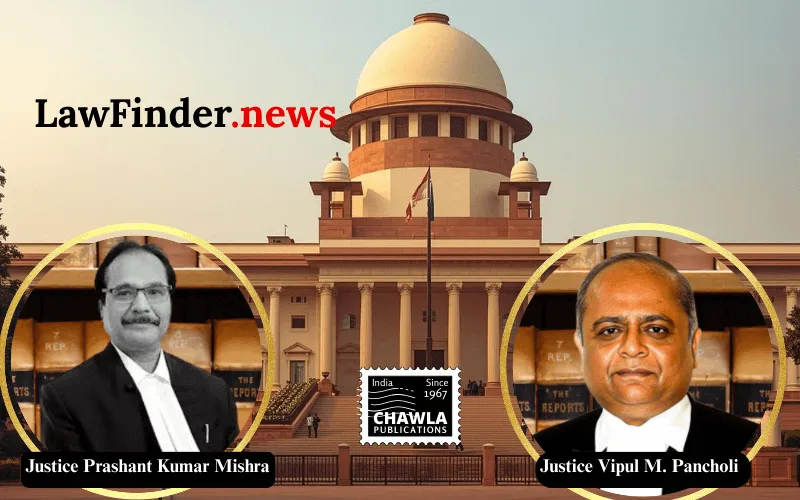
In a significant judgment, the Supreme Court of India has dismissed the appeals filed by Sadachari Singh Tomar, an appellant who challenged the decision of the Indian Council of Agricultural Research (ICAR) to curtail his tenure as Assistant Director General (ADG-ARIS) and revert him to his previous position. The ruling was delivered by a bench comprising Justices Prashant Kumar Mishra and Vipul M. Pancholi, affirming the decisions of the Delhi High Court and the Central Administrative Tribunal (CAT).
The crux of the judgment lies in the apex court's reaffirmation of the limited scope of judicial review in matters of administrative discretion. The court emphasized that judicial intervention is warranted only if the administrative action is found to be arbitrary, irrational, mala fide, or stigmatic. The court clarified that it is not within its purview to evaluate the merits of administrative decisions but rather to assess the decision-making process.
The appellant, Sadachari Singh Tomar, had alleged that his tenure was curtailed in retaliation for his role as a whistle-blower, exposing irregularities in contract awards by ICAR. He contended that the adverse remarks in his Annual Assessment Reports (AARs) were a result of his whistle-blowing activities. However, the Supreme Court found no concrete evidence to support claims of mala fides or retaliation, highlighting the absence of material evidence.
The court also addressed the appellant's claim under Article 311 of the Indian Constitution, which provides protection to civil servants. It concluded that Article 311 was inapplicable as ICAR operates as an autonomous body with its own service rules, and the appellant did not hold a civil post under the Union or State.
Further, the court examined whether the language used in the adverse AARs was stigmatic. It concluded that the remarks, which termed the appellant's performance as 'unsatisfactory' and 'below average,' did not impute misconduct or ineptitude beyond unsuitability, and thus were not stigmatic.
The Supreme Court's decision highlights the importance of administrative discretion and the judiciary's role in ensuring fairness in the decision-making process without overstepping into administrative functions. This ruling reinforces the principle that courts should exercise restraint in service matters unless compelling evidence of injustice or mala fides is presented.
Bottom Line:
Administrative discretion in curtailing tenure of an employee in a position governed by service rules - Judicial review limited to assessing arbitrariness, mala fides, or colorable exercise of power; Courts cannot substitute their evaluation of administrative needs.
Statutory provision(s): Article 311 of the Constitution of India, Administrative Law principles on judicial review, Service Law principles on transfer and reversion, Service Law principles on Adverse Annual Assessment Reports (AARs), Principles of mala fides in administrative action.
Sadachari Singh Tomar v. Union of India, (SC) : Law Finder Doc id # 2890165