New Delhi, Jan 5 The Supreme Court on Monday said the ground of delay in trial would not operate as a trump card for an automatic grant of bail for offences punishable under the stringent Unlawful (Activities) Prevention Act (UAPA).
The top court's observation came while refusing bail to activists Umar Khalid and Sharjeel Imam in the 2020 Delhi riots conspiracy case.
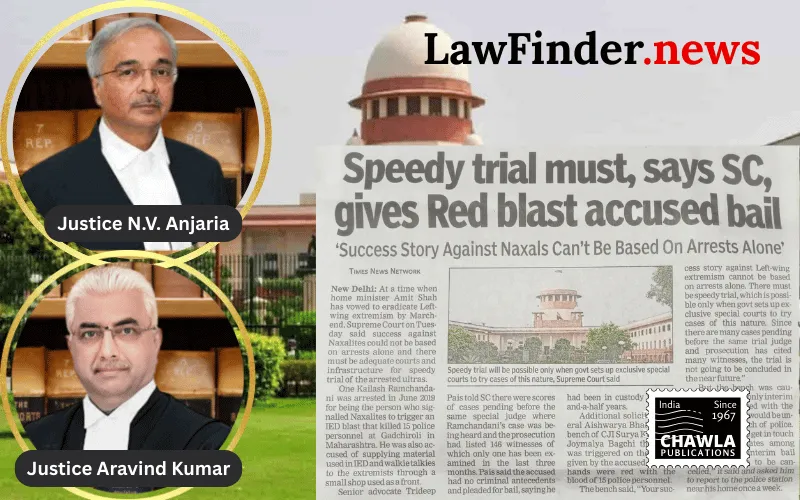
A bench of Justices Aravind Kumar and N V Anjaria said there cannot be a mechanical invocation of prolonged incarceration as a ground for bail in cases involving serious offences under special enactments.
"In prosecutions alleging offences which implicate the sovereignty, integrity or security of the State, delay does not operate as a trump card that automatically displaces statutory restraint. Rather, delay serves as a trigger for heightened judicial scrutiny," the bench said.
It said the outcome of such scrutiny must be determined by a proportional and contextual balancing of legally-relevant considerations.
The bench said the considerations include the gravity and statutory character of the offence alleged, the role attributed to the accused within the alleged design or conspiracy, the strength of the prima facie case as it emerges at the limited threshold contemplated under the special statute and the extent to which continued incarceration has become demonstrably disproportionate so as to offend the guarantee of personal liberty under Article 21 of the Constitution.
The court said a delay in the trial cannot be the sole factor to grant bail in UAPA offences and "claims to liberty must be examined in the totality of circumstances, particularly where allegations implicate organised criminality or matters of public interest".
It rejected the petitioners' submission referring to the K A Najeeb case while seeking bail.
In the Najeeb case, the top court granted bail to an accused under the Unlawful Activities (Prevention) Act (UAPA), 1967, due to prolonged incarceration.
"To read Najeeb as mandating bail solely on account of prolonged incarceration, irrespective of the statutory context or the nature of the allegations, would be to attribute to the decision a consequence it neither intended nor supports.
"Such a construction would also lead to an interpretive absurdity, whereby a special statute enacted by Parliament to address offences implicating the sovereignty, integrity and security of the State would stand effectively neutralised by the mere passage of time, even at a pre-trial stage. Such an outcome cannot be countenanced in constitutional adjudication," the bench said.
The February 2020 riots in northeast Delhi left 53 people dead and more than 700 injured.
The violence erupted during widespread protests against the Citizenship (Amendment) Act (CAA) and the National Register of Citizens (NRC).
The accused moved the apex court, challenging the Delhi High Court's September 2, 2025 order denying them bail in the larger conspiracy case of the riots.
New Delhi, Jan 5 Observing that reasonable grounds exist for believing that allegations against Umar Khalid and Sharjeel Imam are prima facie true, the Supreme Court on Monday refused bail to them in the 2020 Delhi riots conspiracy case but granted it to five others, saying all the accused do not stand on the same footing.
Khalid and Imam, who have been incarcerated since 2020, can file fresh bail applications after the examination of protected witnesses or after one year from today, the court said, as it rejected their contention of delay in trial.
There was a prima facie case against Khalid and Imam under the Unlawful Activities (Prevention) Act, a bench of Justices Aravind Kumar and N V Anjaria said, noting that prosecution material suggests that they were involved in "planning, mobilisation and strategic direction" of the riots.
While the two will remain in jail, activists Gulfisha Fatima, Meeran Haider, Shifa Ur Rehman, Mohd. Saleem Khan and Shadab Ahmad have been given bail by the apex court, which imposed 11 conditions and said any misuse of liberty would attract cancellation of bail.
The court noted that the guarantee of liberty enshrined under Article 21 of the Constitution is of foundational importance, but at the same time, the security of the community, the integrity of the trial process and the preservation of public order are equally legitimate constitutional concerns.
The two (Khalid and Imam) stand on qualitatively different footing as compared to the other accused, the court said.
The prosecution prima facie disclosed "a central and formative role" and "involvement in the level of planning, mobilisation and strategic direction extending beyond episodic and localised acts", the bench said.
"...this court is satisfied that reasonable grounds exist for believing that the accusations against Umar Khalid are prima facie true," the bench said, while citing prosecution material "including the chronology of meetings, the alleged articulation and propagation of the chakka jam strategy, the operation of coordinating committees and groups...".
It also referred to "the protected witness statements alleging preparatory and escalation-related discussions, the pleaded movement of protest activity into mixed-population zones, and the alleged systemic disruption of civic life in the national capital".
The February 2020 riots in northeast Delhi broke out during protests against the Citizenship (Amendment) Act (CAA) and the National Register of Citizens (NRC), leaving 53 people dead and more than 700 injured.
The Delhi Police had arrested a total of 18 people in the conspiracy case. Out of them, 11 accused have got bail so far.
The apex court order on Monday said that a delay in trial does not operate as a "trump card" which automatically displaces statutory safeguards.
"All the appellants do not stand on equal footing as regards culpability. The hierarchy of participation emerging from the prosecution's case requires the court to examine each application individually," the bench said, adding that the roles attributed to them are different.
"This court is satisfied that the prosecution material disclosed a prima facie allegation against the appellants, Umar Khalid and Sharjeel Imam... This stage of proceedings does not justify their enlargement on bail," the apex court said.
The apex court cited Section 43D (5) of the UAPA, which requires the court to deny bail if, on perusal of a case diary or chargesheet, it finds that there are reasonable grounds for believing that the accusation against such a person is prima facie true.
"The material suggests involvement at the level of planning, mobilisation, and strategic direction, extending beyond episodic or localised acts. The statutory threshold under Section 43D (5) of the Unlawful Activities (Prevention) Act, 1967, therefore stands attracted qua these appellants," it said.
With regard to Fatima's case, the top court said she did not exercise independent command, resource control, or strategic oversight over multiple protest sites during the agitation against the Citizenship (Amendment) Act.
"The allegation that Gulfisha Fatima mobilised local women and coordinated protest-site logistics, though relevant to the prosecution's case, does not presently disclose that she exercised independent command, resource control, or strategic oversight over multiple protest sites.
"The prosecution itself asserts that directions were conveyed to her by others higher in the asserted hierarchy. In these circumstances, this court finds that the level of attributed agency and control does not justify continued incarceration once the investigative purpose stands substantially fulfilled," the bench said.
Directing the trial court to expedite the process of bail, the bench imposed 11 conditions and said the misuse of liberty would attract the cancellation of the bail.
"Right to liberty under Article 21 of the Constitution requires the State to justify prolonged pre-trial custody," the bench said.
The top court said that while bail in UAPA cases is not given as a matter of routine, the law does not mandate the denial of bail as default. It also does not exclude the court's jurisdiction to allow bail.
"The guarantee of liberty enshrined under Article 21 of the Constitution is of foundational importance, and no constitutional court can be unmindful of the gravity of restraining liberty before guilt is adjudicated.
"At the same time, the Constitution does not conceive liberty in isolation. The security of the community, the integrity of the trial process, and the preservation of public order are equally legitimate constitutional concerns," the bench said.
The apex court said where Parliament has prescribed a distinct statutory threshold for the grant of bail, and where the prosecution places prima facie material suggesting organised and deliberate activity affecting public order and security of the Nation, it cannot turn a "Nelson's eye" to such material merely because incarceration is prolonged or liberty is invoked in the abstract.
"Equally, where continued detention is not shown to be necessary to serve a legitimate purpose recognised by law, the Court must not hesitate to restore liberty, subject to stringent conditions that safeguard the larger public interest," the bench said.
Imam was arrested on January 28, 2020, for speeches made during anti-CAA protests. He was later arrested in a larger conspiracy case in August 2020. Khalid was arrested on September 13, 2020 on charges of delivering provocative speeches on February 24 and 25 when Donald Trump, in his first term as president, visited India.
Strongly opposing the bail pleas, Delhi Police said the riots were not spontaneous but an orchestrated, pre-planned and well-designed attack on India's sovereignty.
All seven accused were booked under the stringent anti-terror UAPA and provisions of the Indian Penal Code (IPC) for allegedly being the "masterminds" of the riots.
According to Section 16 of the UAPA, "Whoever commits a terrorist act shall, if such act has resulted in the death of any person, be punishable with death or imprisonment for life, and shall also be liable to fine."
The accused moved the apex court, challenging the Delhi High Court's September 2 order denying them bail.
Gulfisha Fatima v. State (Govt. of NCT of Delhi), (SC) : Law Finder Doc Id # 2833291