Court Dismisses Application for Suspension of Sentence, Cites Grave Nature of Offences and Lack of New Circumstances
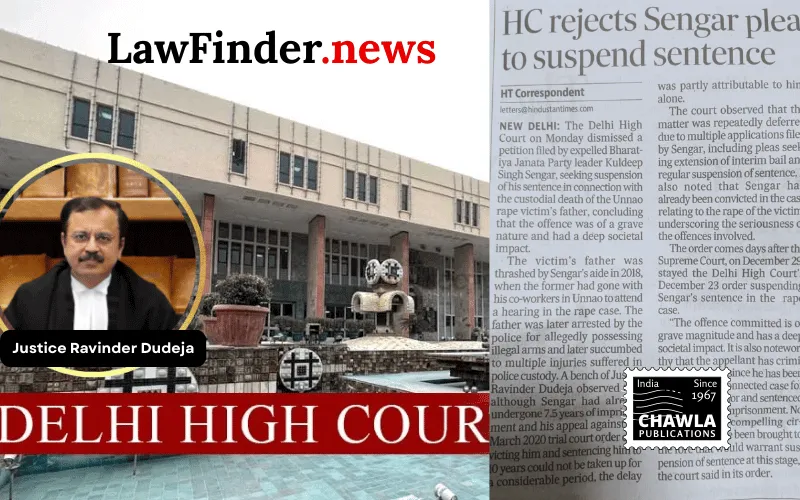
In a significant ruling, the Delhi High Court has rejected the application for suspension of sentence and release on bail of former Uttar Pradesh legislator, Kuldeep Singh Senger, who was convicted of grave offences including culpable homicide not amounting to murder, conspiracy, and various other charges under the Indian Penal Code (IPC) and Arms Act. The decision, delivered by Justice Ravinder Dudeja, underscores the gravity of the crimes and the absence of any new compelling circumstances since the prior rejection of a similar application.
Senger, who has been in custody since April 2018, was appealing the judgment and order passed by the District and Sessions Judge, West, Tis Hazari Courts, Delhi, which had convicted him of serious charges, including the rape of a minor, and sentenced him to rigorous imprisonment for a total of ten years. The High Court emphasized that the suspension of sentence is not a matter of right and must be judiciously considered in the context of the nature and gravity of the offence, threat perception, and antecedents of the appellant.
The court noted that the appellant has already served approximately 7.5 years of his sentence, but stated that prolonged incarceration alone cannot justify the suspension of sentence. It was observed that the appellant’s previous application for suspension of sentence had been dismissed, and there were no new developments that could warrant a reassessment of the situation.
The prosecution, represented by the Central Bureau of Investigation (CBI), opposed the bail application, highlighting Senger's pivotal role in the commission of the crime and his conviction in a related rape case. The victim's counsel expressed concerns about potential threats and interference with the judicial process, given Senger's political influence.
The High Court reiterated the principles laid down by the Supreme Court in cases like Omprakash Sahni v. Jai Shankar Chaudhary and Shivani Tyagi v. State of U.P., where it was held that suspension of sentence requires a distinct standard, considering the prima facie sustainability of the conviction, the gravity of the offence, and societal impact. The Court also referenced the Supreme Court's direction to transfer trials from Uttar Pradesh to Delhi, reflecting the severity of threat perception in the case.
Ultimately, the Court concluded that no exceptional or compelling circumstances were presented to warrant the suspension of sentence. The application was dismissed, with the court suggesting that the appeal could be expedited for an early hearing on merits.
Bottom Line:
Suspension of sentence under Section 389 of the Code of Criminal Procedure, 1973, is not a matter of right and requires consideration of the gravity of the offence, antecedents of the convict, potential threat perception, and the absence of new compelling circumstances.
Statutory provision(s): Bharatiya Nagarik Suraksha Sanhita, 2023 Sections 430, 528, Code of Criminal Procedure, 1973 Section 389, Indian Penal Code Sections 120B, 193, 201, 203, 211, 323, 341, 304 Part II, Arms Act Sections 3, 25
Kuldeep Singh Senger v. Central Bureau of Investigation, (Delhi) : Law Finder Doc Id # 2840606