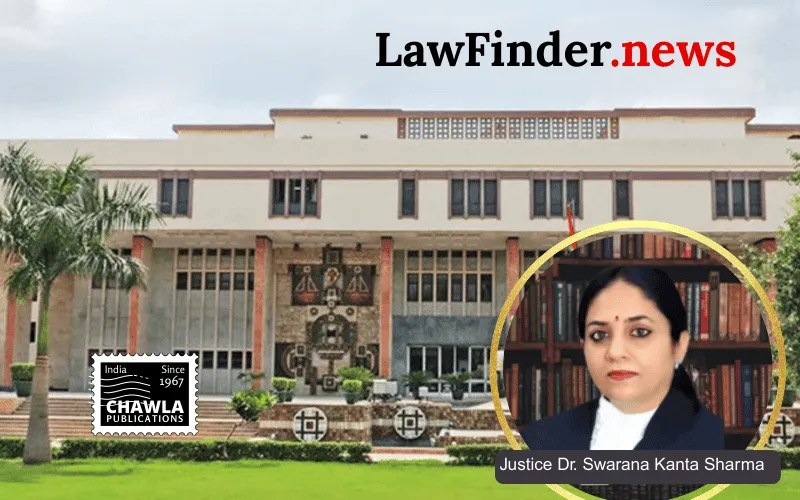
Justice Swarana Kanta Sharma addresses vilification campaigns; emphasizes the protection of judicial dignity and independence.
In a significant development, the Delhi High Court, under Justice Swarana Kanta Sharma, has initiated criminal contempt proceedings against various political figures, including Arvind Kejriwal, Manish Sisodia, and others. The proceedings stem from a series of social media posts, public statements, and campaigns that allegedly sought to scandalize and undermine the judiciary, specifically targeting Justice Sharma.
The judgment, dated May 14, 2026, outlines a comprehensive narrative of how certain respondents, displeased with prior judicial orders, resorted to social media platforms and public campaigns to vilify the judge and question the integrity of the court. The court found these actions to fall under the ambit of criminal contempt as defined under Section 2(c) of the Contempt of Courts Act, 1971.
Justice Sharma emphasized that while the judiciary is open to fair criticism, the organized efforts to malign the court and create a false public narrative against its impartiality and independence cannot be tolerated. The judgment highlighted several instances of misleading social media posts and videos, including edited content misrepresenting a speech delivered by Justice Sharma at an academic event in Varanasi, falsely linking it to political affiliations.
The court observed that such actions not only scandalize the judiciary but also threaten to erode public confidence in the justice delivery system. The judgment underscored the constitutional duty of the courts to protect the dignity and independence of the judiciary from organized assaults disguised as public discourse.
Justice Sharma, while initiating the contempt proceedings, decided to transfer the main matter to another bench to maintain judicial propriety and avoid any perception of bias. The court's decision to initiate contempt proceedings was framed not as a recusal but as a necessity to address the deliberate attempts to scandalize the court.
The judgment serves as a stern reminder of the limits of free speech, particularly when it crosses into the territory of obstructing justice and undermining judicial authority. The court has directed the registry to proceed with the contempt proceedings and reassign the main case, ensuring that judicial processes are not influenced by external pressures.
This development marks a pivotal moment in the ongoing discourse around the balance between free speech and the sanctity of judicial proceedings, reinforcing the judiciary's role as an independent pillar of democracy.
Bottom line:-
Social media campaigns and public vilification of a judge or judiciary, aimed at influencing judicial outcomes, scandalizing courts, or obstructing the administration of justice, fall within the ambit of criminal contempt under Section 2(c) of the Contempt of Courts Act, 1971.
Statutory provision(s): Contempt of Courts Act, 1971 Sections 2(c) and 15
Central Bureau of Investigation v. Kuldeep Singh, (Delhi) : Law Finder Doc id # 2898794