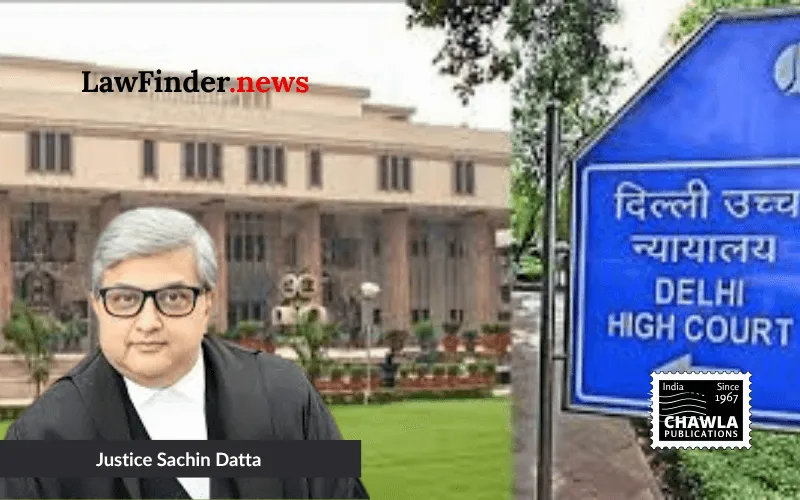
Landmark judgment balances fundamental right to informational privacy with open justice, mandates search engines and legal databases to de-index and disable name-based search functionality for resolved cases, while preserving public access to judicial records.
In a landmark judgment delivered on May 29, 2026, the Delhi High Court has firmly recognized the "right to be forgotten" as a constitutional facet of the right to informational privacy guaranteed under Article 21 of the Indian Constitution. The bench, presided over by Justice Sachin Datta, addressed a batch of petitions involving individuals seeking relief from perpetual accessibility and name-based searchability of judicial records that bear their names in the digital public domain.
The petitioners ranged from individuals acquitted of criminal charges, parties to matrimonial disputes, to those incidentally named in judicial records. They contended that the continued availability of such information via internet search engines and legal databases caused disproportionate harm to their dignity, reputation, and life prospects, far exceeding any legitimate public interest.
Recognizing the "right to be forgotten" as an essential aspect of informational privacy, the Court held that individuals have the right to seek removal or de-indexing of personal information from name-based search results when such data is outdated, irrelevant, or disproportionate. The Court emphasized that this right is enforceable even against private non-State actors such as Google LLC and Indian Kanoon, which are active processors of personal data and not mere passive conduits.
The judgment elucidates the principle of open justice, affirming that while judicial records must exist, be maintained, and accessible to those with a legitimate purpose, open justice does not mandate permanent, unlimited name-based searchability via commercial search engines. To balance open justice with privacy, the Court endorsed de-indexing and masking as appropriate measures. De-indexing removes specific URLs from name-based search results without erasing judicial records, which remain accessible through case numbers or citations. Masking involves redacting personal identifiers in public digital records while preserving un-redacted internal versions.
The Court laid down detailed legal parameters for granting de-indexing and masking relief, considering factors such as the nature and sensitivity of the information, elapsed time, public role of the individual, accuracy, impact on dignity, and public interest. Acquittals, discharges, quashings, settlements, and private matrimonial or civil disputes generally justify relief, whereas serious convictions and matters involving public figures do not.
Notably, the Court directed all concerned search engines, including Google LLC, and legal databases like Indian Kanoon, to globally de-index relevant judgments, orders, and news articles from name-based search results, and disable name-based search functionality where applicable. Petitioners receiving de-indexing relief were granted liberty to seek masking from the courts that rendered the original orders. The Ministry of Electronics and Information Technology (MEITY) was tasked with ensuring compliance and filing affidavits within four weeks.
The judgment also addressed preliminary objections regarding the maintainability of writ petitions against private entities. It reaffirmed that fundamental rights under Article 21 are enforceable against non-State actors, including private intermediaries that process personal data, thereby validating the Court’s jurisdiction to issue directions to such entities.
This decision marks a significant development in Indian jurisprudence on privacy rights in the digital age, striking a delicate balance between protecting individual dignity and upholding transparency and freedom of expression. It aligns India with global trends recognizing the right to be forgotten while safeguarding the principle of open justice.
Bottom Line:
Fundamental Rights - Recognition and enforcement of the "right to be forgotten" as a facet of the fundamental right to informational privacy under Article 21 of the Constitution of India, balancing it with the principle of open justice and freedom of expression.
Statutory provision(s): Article 21 of the Constitution of India, Information Technology Act, 2000, Information Technology (Intermediary Guidelines and Digital Media Ethics Code) Rules, 2021, Digital Personal Data Protection Act, 2023, Sections 228A IPC (Bharatiya Nyaya Sanhita, 2023)
Laksh Vir Singh Yadav v. Union of India, (Delhi) : Law Finder Doc id # 2911529