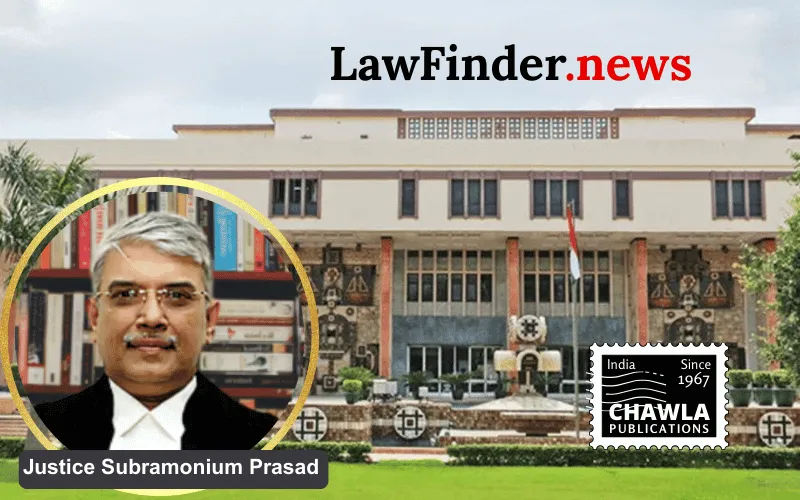
Court affirms Tribunal's decision on the limitation of claims and rejects plea for exclusion of time under Section 14 of the Limitation Act, 1963.
In a significant judgment, the Delhi High Court has upheld the decision of the Arbitral Tribunal in the case of Sahaj Bharti Travels versus HCL Technologies Ltd., dismissing the claims made by Sahaj Bharti Travels as barred by limitation. The judgment, delivered by Justice Subramonium Prasad, reinforces the importance of adhering to statutory timelines in arbitration proceedings and the strict application of limitation laws.
Sahaj Bharti Travels, a proprietorship firm engaged in providing transport services, had entered into a service agreement with HCL Technologies Ltd., an Indian multinational IT services company. The agreement, effective from April 20, 2015, to December 31, 2018, included a Minimum Running Guarantee (MG) clause, which became the focal point of dispute between the parties.
The petitioner had filed a petition under Section 34 of the Arbitration and Conciliation Act, 1996, challenging the arbitral award passed on September 4, 2025, which rejected their claims for unpaid MG dues amounting to Rs. 3,27,15,438/-, including interest and costs. The Tribunal had ruled that the claims were time-barred, as the notice invoking arbitration was issued after the expiration of the limitation period, even considering the extension due to the COVID-19 pandemic.
The High Court meticulously examined the Tribunal's findings, which highlighted that the MG payment claims arose monthly, and clubbing these claims did not revive the limitation for individual claims. The Court concurred with the Tribunal that the petitioner failed to raise monthly invoices within 60 days as stipulated in the agreement, thus barring the claims by limitation.
Additionally, the Court dismissed the petitioner's plea for exclusion of time under Section 14 of the Limitation Act, 1963, which allows for the exclusion of time when proceedings are pursued in good faith before a forum lacking jurisdiction. The Court noted that the petitioner's application before the National Company Law Tribunal (NCLT) was dismissed on merits, not on jurisdictional grounds, disqualifying them from claiming the benefit under Section 14.
Justice Prasad emphasized that Section 34 of the Arbitration and Conciliation Act, 1996, provides limited grounds for setting aside an arbitral award, including contravention of the fundamental policy of Indian law, notions of morality or justice, or patent illegality. In the present case, none of these parameters were met, reinforcing the Tribunal's decision.
This judgment underscores the importance of adhering to statutory timelines and the rigorous application of limitation laws in arbitration proceedings. The dismissal of the petition serves as a reminder of the limited scope for judicial interference in arbitral awards, maintaining the sanctity and finality of arbitration as a dispute resolution mechanism.
Bottom line:-
Arbitration and Conciliation Act, 1996 - Claims barred by limitation cannot be revived by clubbing monthly claims cumulatively or by invoking section 14 of the Limitation Act, 1963, unless conditions for exclusion of time are met.
Statutory provision(s): Arbitration and Conciliation Act, 1996 Sections 34, 21; Limitation Act, 1963 Sections 14, 22; Insolvency and Bankruptcy Code, 2016 Section 9.
Sahaj Bharti Travels v. HCL Technologies Ltd., (Delhi) : Law Finder Doc id # 2889169