Court Exempts Property from Doctrine of Lis Pendens, Citing Lack of Valid Contractual Agreement
In a significant judgment, the Delhi High Court has dismissed the appeal filed by Earthz Urban Spaces Pvt. Ltd. against the decision of the Single Judge which exempted the property at B-8, Pamposh Enclave, New Delhi, from the doctrine of lis pendens, thus allowing the respondents to freely deal with the property despite ongoing litigation.
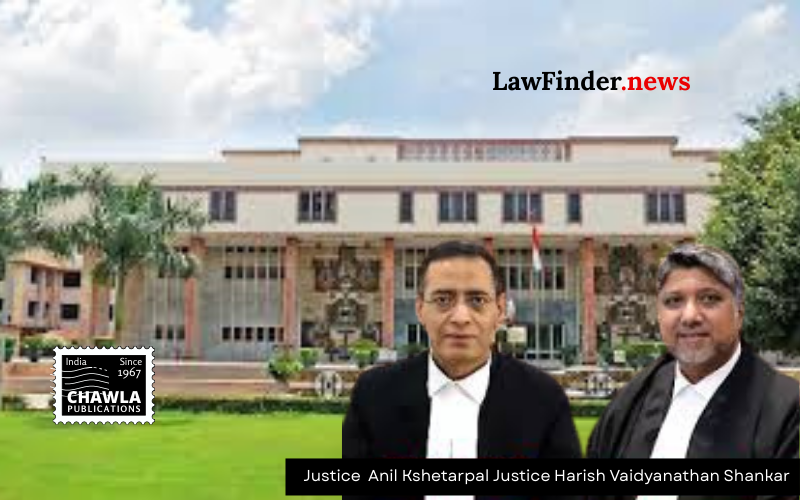
The Division Bench of Justices Anil Kshetarpal and Harish Vaidyanathan ruled that the appellant failed to establish the existence of a concluded and enforceable oral agreement for the sale of the property. The court held that the electronic communications and WhatsApp messages cited by Earthz Urban Spaces only indicated ongoing negotiations, and not a binding contract.
Central to the court's decision was the Memorandum of Understanding (MoU) executed on June 2, 2021, between the parties. The MoU explicitly stated it was non-binding and solely aimed at facilitating favorable tax treatment for the respondents. Clauses within the MoU underscored that no enforceable rights were created by it, and that any sale deed would supersede its terms.
The judgment further highlighted that the appellant's claim of having made a part-payment was unsubstantiated due to the absence of documentary proof such as receipts or bank statements evidencing encashment of the alleged payments. Moreover, one of the cheques was issued in a mis-spelt name, raising doubts about the authenticity of the claim.
The court emphasized that the doctrine of lis pendens should not be misused as a tool for speculative adventurism, and recognized its discretion to exempt properties from its application to protect genuine property owners from vexatious litigation. In this case, the court found the appellant's suit to be tenuous and speculative, designed to impede the property's marketability.
The judgment reiterated principles laid down by the Supreme Court in Vinod Seth v. Devender Bajaj, underscoring that the doctrine does not annul conveyances but renders them subservient to the litigation's outcome. Courts possess the power to exempt properties from its operation in appropriate cases, subject to conditions that protect the interests of the property owners.
The appeal was dismissed with costs of Rs. 5,00,000 imposed on Earthz Urban Spaces, with the court remarking that the case was an abuse of the process of law and devoid of merit.
Bottom Line:
Doctrine of lis pendens does not annul the conveyance by a party to the suit but renders it subservient to the rights of other parties to the litigation.
Statutory provision(s): Transfer of Property Act, 1882 Section 52, Indian Contract Act, 1872 Section 10, Specific Relief Act, 1963 Section 21
Earthz Urban Spaces Pvt. Ltd. v. Ravinder Munshi, (Delhi)(DB) : Law Finder Doc Id # 2792431