Court affirms that policy decisions on reservations and relaxations fall under the purview of the Executive and Legislature, not judicial review.
In a significant judgment, the Delhi High Court has dismissed a writ petition challenging the denial of age and attempt relaxations to candidates belonging to the Economically Weaker Sections (EWS) category in government recruitment. The court emphasized that policy decisions, including those related to reservations and relaxations, fall within the exclusive domain of the Legislature and the Executive, and courts should not interfere unless the policy is unconstitutional or arbitrary.
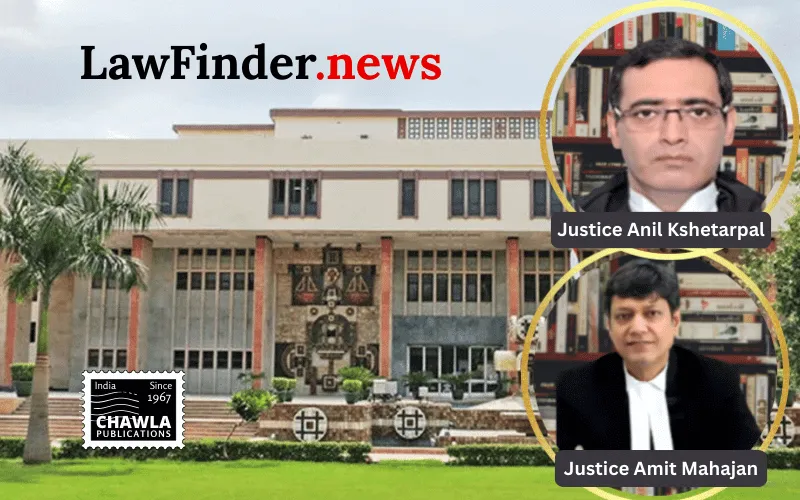
The bench, comprising Justices Anil Kshetarpal and Amit Mahajan, heard the case titled Anish Arun & Ors. v. Union of India & Ors., where the petitioners, who belong to the EWS category, sought parity with Scheduled Castes (SC), Scheduled Tribes (ST), and Other Backward Classes (OBC) in terms of age and attempt relaxations in direct recruitment under the Central Government. They argued that the denial of such relaxations was discriminatory and violative of Articles 14 and 16(1) of the Constitution.
The court, however, found that the EWS category, introduced by the 103rd Constitutional Amendment in 2019, is fundamentally distinct from the SC/ST/OBC categories. The reservation for EWS addresses economic deprivation rather than historical social discrimination, which underpins the relaxations provided to SC/ST/OBC categories. The judgment highlighted that economic status is fluid and can change over time, unlike caste, which is a fixed identity and carries long-lasting stigma.
The court reiterated that it is not within its purview to amend policy decisions or test their merits unless they violate fundamental rights or are manifestly arbitrary. Citing previous judgments, the court noted that the Executive is best positioned to formulate policies based on expert opinion and socio-economic considerations.
Furthermore, the judgment addressed the petitioners' contention regarding the disparity in policies across different states and the central government. The court clarified that policy differences do not amount to arbitrariness, and the Central Government is not obligated to mirror state policies.
In conclusion, the Delhi High Court upheld the government's policy framework, which provides a 10% reservation to EWS candidates without ancillary relaxations. The court found no grounds to declare the policy unconstitutional or arbitrary and dismissed the petition.
Bottom Line:
Policy decisions, including reservations and relaxations, fall within the exclusive domain of the Legislature and the Executive. Courts, while exercising jurisdiction under Article 226, will not interfere unless the policy is unconstitutional, arbitrary, or violative of fundamental rights.
Statutory provision(s):
Articles 14, 16(1), 16(6), and 226 of the Constitution of India.
Anish Arun v. Union Of India, (Delhi)(DB) : Law Finder Doc id # 2883976