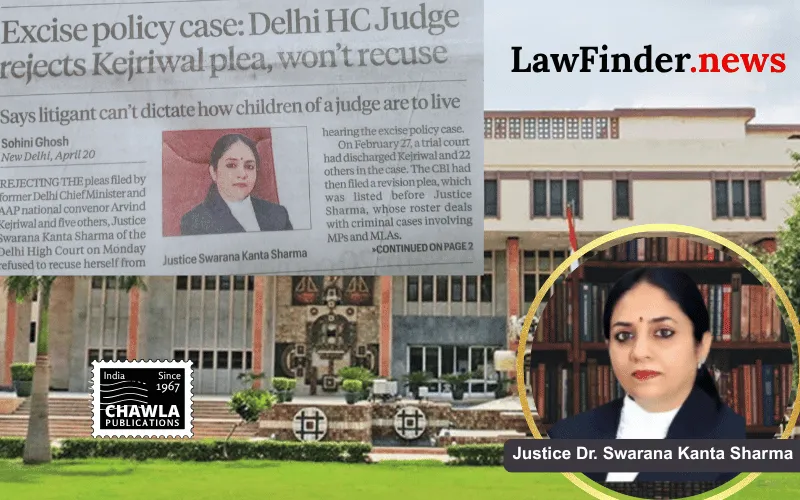
Justice Swarana Kanta Sharma dismisses apprehensions of bias despite interim observations and professional affiliations; stresses sanctity of judicial independence and duty to deliver justice impartially
In a landmark judgment dated April 20, 2026, the Delhi High Court, presided over by Justice Dr. Swarana Kanta Sharma, emphatically rejected multiple applications seeking her recusal from hearing a high-profile criminal matter involving accused persons including prominent political figures such as Arvind Kejriwal and Manish Sisodia. The case relates to allegations under the Prevention of Money Laundering Act (PMLA), 2002, where the Central Bureau of Investigation (CBI) challenged the discharge order passed by the trial court.
The recusal pleas were predicated on several grounds, including apprehensions of bias arising from:
- Prima facie observations made by the Court in an interim order dated March 9, 2026, which the accused claimed demonstrated prejudgment without hearing their side.
- Alleged inadequate service of process and undue haste in proceedings.
- Previous detailed judicial findings by the same Court in related matters, including bail and arrest challenges under PMLA, which were argued to indicate pre-formed opinions.
- The Judge’s attendance at legal programmes organized by the Akhil Bharatiya Adhivakta Parishad, alleged to be ideologically opposed to the accused’s political affiliations.
- Professional engagements of the Judge’s relatives as panel counsel on government panels, claimed to create a conflict of interest.
Justice Sharma extensively analyzed these contentions and underscored the principles governing judicial recusal in India. The Court clarified that mere prima facie observations in interim orders are a routine judicial practice to justify granting relief and do not amount to bias or prejudgment. The proper remedy for any grievance against such orders lies in appellate challenge before higher courts, not in demanding recusal. Furthermore, the Court noted that the accused had been served through their trial counsels who were also representing them before the High Court, negating claims of improper service.
Regarding previous judgments and findings by the Court in bail and arrest matters, the judgment highlighted that such findings are necessarily prima facie and limited to the scope of the proceedings at that stage. They do not amount to subject-matter bias or preclude the Court from hearing connected matters. The Court dismissed the claim that ideological bias could be inferred from attending legal seminars, emphasizing that judicial participation in professional legal forums is routine and devoid of political connotations.
On the alleged conflict of interest due to the professional engagements of the Judge’s relatives, the Court held that no direct nexus or impact on the present case was shown. The mere fact of empanelment as government counsel is a professional engagement and cannot be imputed as bias. The Court cautioned against allowing social media narratives or unfounded insinuations to interfere with judicial independence.
Justice Sharma further elaborated on the legal test for recusal, emphasizing that a reasonable apprehension of bias must be assessed objectively by a fair-minded and informed observer. Mere subjective suspicion or unease of a litigant, especially without tangible evidence, is insufficient. The Court stressed the balance between avoiding actual bias and preventing abuse of process through frivolous recusal applications. Succumbing to such unfounded allegations would undermine the judiciary’s independence and open floodgates to forum shopping.
Concluding with a powerful affirmation of judicial duty, Justice Sharma stated that the Court would not recuse itself in the absence of real, substantiated grounds. The applications for recusal were accordingly dismissed, and the Court committed to proceeding with the hearing of the main petition impartially and with judicial discipline.
This judgment serves as a robust reaffirmation of the sanctity of judicial independence against attempts to influence or intimidate through unsubstantiated allegations. It also clarifies the jurisprudence on interim orders, service of process, and the scope of reasonable apprehension of bias, providing guidance for future recusal applications.
Bottom Line:
Recusal of Judge - Mere apprehension or personal perception of bias by a litigant, without any tangible material or reasonable basis, cannot be a ground for recusal of a Judge - Interim orders containing prima facie observations do not amount to prejudgment or bias.
Statutory provision(s): Prevention of Money Laundering Act, 2002, Sections 19 and 45
Central Bureau of Investigation v. Kuldeep Singh, (Delhi) : Law Finder Doc id # 2885805