Supreme Court Quashes Proceedings Against Director in Cheque Bounce Case, Mere Board Resolution Signatures Do Not Establish Director's Involvement in Day-to-Day Company Operations
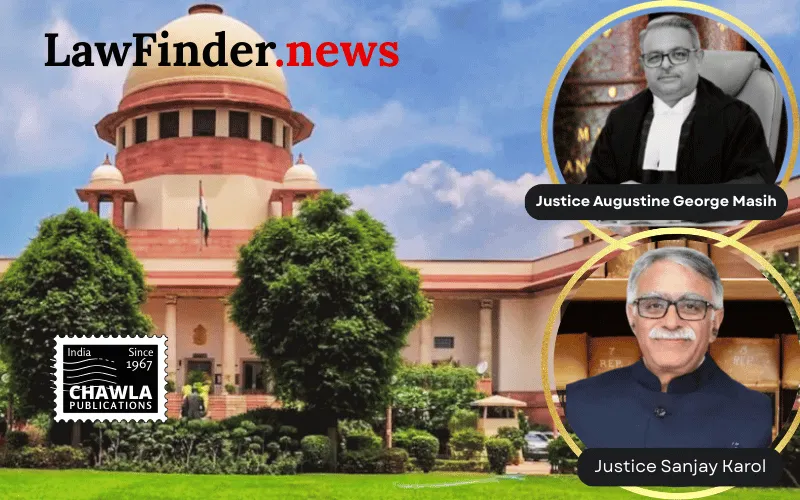
In a significant ruling, the Supreme Court of India quashed proceedings against Saroj Pandey, a director of Projtech Engineering Private Limited, who was embroiled in a cheque bounce case under the Negotiable Instruments Act, 1881 (NI Act). The apex court emphasized that mere signing of Board Resolutions does not automatically establish a director's involvement in the day-to-day operations of a company. The judgment was delivered by a bench comprising Justices Sanjay Karol and Augustine George Masih.
The case arose when the Metropolitan Magistrate, Dwarka Courts, New Delhi, issued a summoning order against Pandey and other company officials, following the return of cheques issued by the company for insufficient funds. The cheques, amounting to 50 lakhs, were issued as payment for iron and steel supplies.
Pandey sought relief from the High Court of Delhi, which refused to exercise its inherent powers under Section 482 of the Code of Criminal Procedure, 1973, leading to an appeal in the Supreme Court. The Supreme Court, upon reviewing the case, found that the High Court erred in its judgment by relying solely on Pandey’s signature on Board Resolutions as evidence of her involvement in the company’s management.
The Supreme Court reiterated the established legal position that for a director to be prosecuted under Section 141 of the NI Act, there must be specific averments demonstrating that the director was in charge of and responsible for the company's business at the time of the offence. The court cited previous judgments, including S.M.S. Pharmaceuticals Ltd. v. Neeta Bhalla, and Gunmala Sales (P) Ltd. v. Anu Mehta, to support its decision.
Justice Karol noted that a Board Resolution signifies decisions taken by the board but does not imply that each director is involved in the company's daily operations. The judgment clarified that without specific allegations of a director's role in the misconduct, proceedings against them are unsustainable.
Furthermore, the Supreme Court addressed the High Court's interpretation of Section 482, CrPC, concluding that inherent powers are not restricted even when revisional jurisdiction under Section 397 has been exercised. The court emphasized that the High Court retains its authority to prevent abuse of process and ensure justice.
The ruling is expected to have far-reaching implications for directors facing similar charges, reinforcing the necessity of establishing concrete involvement in a company's day-to-day affairs for liability under the NI Act.
Statutory provision(s): Negotiable Instruments Act, 1881 Sections 138, 141; Code of Criminal Procedure, 1973 Sections 397, 482.
Saroj Pandey v. State (Govt. of NCT of Delhi), (SC) : Law Finder Doc id # 2879067