Supreme Court Quashes Conviction in Cheque Bounce Case, Allows Compounding Virender Singh Dongwal Released from Prison After Settlement with Manju Aggarwal and Payment of Compounding Costs
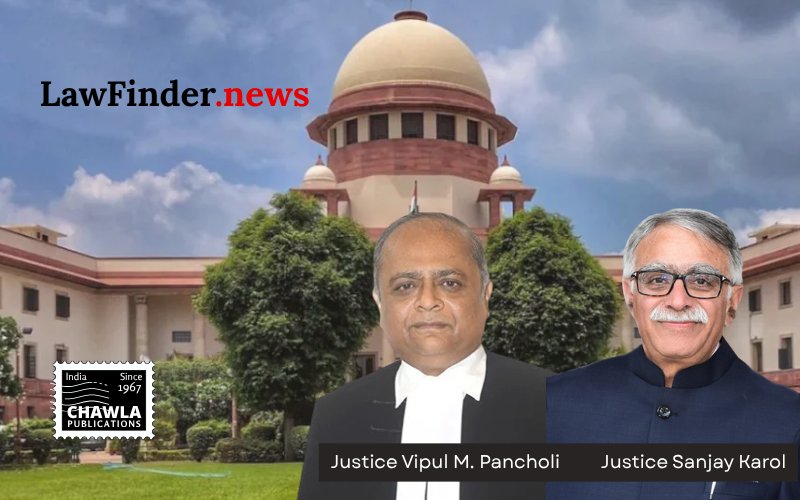
In a notable decision, the Supreme Court of India has quashed the conviction of Virender Singh Dongwal in a cheque bounce case, following a compromise reached between the parties involved. The judgment, delivered by a bench comprising Justices Sanjay Karol and Vipul M. Pancholi, highlights the quasi-criminal nature of offences under Section 138 of the Negotiable Instruments Act, 1881, and the provision for their compounding under Section 147 of the Act.
The appellant, Virender Singh Dongwal, had been convicted by the Judicial Magistrate First Class (JMIC), Faridabad, for the dishonour of cheques amounting to Rs. 11,37,827/- issued to the respondent, Manju Aggarwal, following business transactions between their respective firms. The Trial Court's decision was subsequently upheld by the High Court of Punjab and Haryana, prompting Dongwal to approach the Supreme Court.
During the proceedings, the Supreme Court was informed of a Memorandum of Settlement between the parties, with Dongwal agreeing to pay a compromised sum of Rs. 6,65,000/-, of which Rs. 4,00,000/- had already been paid. The appellant assured the Court of the readiness of the remaining amount, Rs. 2,65,000/-, to be paid upon the final order of the Court.
The Court, citing the recent judgment in the Sanjabij Tari case, noted the guidelines for the compounding of offences under the NI Act. It underscored that the offence is compoundable, and the legislative intent is to ensure the payment of money and uphold the credibility of cheques. The judgment also referenced the guidelines laid down in Damodar S. Prabhu's case, which were modified to include specific costs associated with compounding at different judicial stages.
Consequently, the Supreme Court quashed the orders of the lower courts, ordering the immediate release of Dongwal from custody, subject to the payment of 10% of the cheque amount as compounding costs, amounting to Rs. 1,13,783/-. This amount is to be deposited with the Supreme Court Legal Services Committee within four weeks.
This decision reaffirms the judiciary's role in facilitating settlements and ensuring justice in cheque bounce cases, aligning with the legislative aim to maintain the integrity of financial transactions.
Bottom Line:
Offence under Section 138 of the Negotiable Instruments Act, 1881, is quasi-criminal in nature and explicitly made compoundable under Section 147 of the Act. Compounding of offence allowed in light of a compromise between the parties, subject to payment of compounding costs as per guidelines.
Statutory provision(s): Negotiable Instruments Act, 1881 Sections 138, 147
Virender Singh Dongwal v. Manju Aggarwal, (SC) : Law Finder Doc Id # 2814029