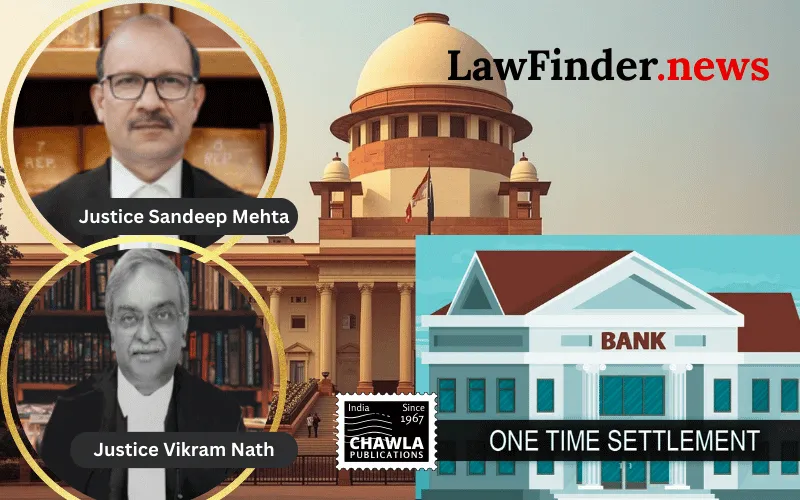
Supreme Court Revives CBI's Case Against Sarvodaya Highways Ltd for Alleged Economic Offences, Apex Court Criticizes Punjab and Haryana High Court's Decision to Quash Proceedings, Emphasizes Societal Impact of Economic Crimes
In a landmark judgment, the Supreme Court of India has reinstated criminal proceedings against M/s. Sarvodaya Highways Ltd and its directors, reversing the Punjab and Haryana High Court's earlier decision to quash the case based on a one-time settlement with the bank. The judgment, delivered by Justices Vikram Nath and Sandeep Mehta, underscores the importance of judicial scrutiny in cases involving economic offences that significantly impact the public exchequer.
The Central Bureau of Investigation (CBI), which had initially filed the charges against Sarvodaya Highways Ltd, argued that the High Court erred in dismissing the FIR and chargesheet without adequately considering the fabricated documents and misrepresentation that led to a significant financial loss for the bank, which is a matter of public interest.
The case originated from a complaint by the State Bank of Bikaner and Jaipur, now merged with the State Bank of India, which accused Sarvodaya Highways Ltd of defrauding the bank by submitting false information and fabricated work orders to secure credit facilities worth Rs. 60 crores. Despite the company's settlement of Rs. 41 crores with the bank, the Supreme Court highlighted that this amount did not cover the total liabilities, leaving a substantial deficit impacting the public exchequer.
The Supreme Court's judgment emphasized that economic offences cannot be treated as private wrongs, as they have a broader societal impact. The court criticized the High Court for failing to consider these aspects and for quashing the proceedings solely based on the financial settlement. The judgment referenced previous rulings where it was established that economic offences against public institutions are societal wrongs and cannot be dismissed simply because of a monetary settlement.
The court highlighted the critical role of judicial bodies in safeguarding public interest, particularly in cases involving manipulation of financial systems, and reiterated that such offences pose a threat to the well-being of society as a whole. The Supreme Court's decision restores the proceedings against the company and its directors, including the bank manager involved in the alleged conspiracy.
This judgment reaffirms the judiciary's stance on maintaining stringent oversight over cases of economic fraud, ensuring that settlements do not undermine the collective interests of society.
Bottom Line:
Economic offences affecting the public exchequer cannot be quashed merely on the basis of a one-time settlement between the defaulter and the bank. Such offences have societal impact and require thorough judicial scrutiny.
Statutory provisions: Section 482 of the Criminal Procedure Code, 1973 [Section 528 of Bharatiya Nagarik Suraksha Sanhita, 2023], Sections 120B, 406, 420, 467, 468, 471 of the Indian Penal Code, 1860, Sections 13(2) read with 13(1)(d) of the Prevention of Corruption Act, 1988.
Central Bureau of Investigation v. M/s. Sarvodaya Highways Ltd., (SC) : Law Finder Doc id # 2812785