Supreme Court Overturns High Court's Decision on Advocate's Withdrawal Issue Apex Court Reinforces Limits of High Court's Supervisory Powers Under Article 227
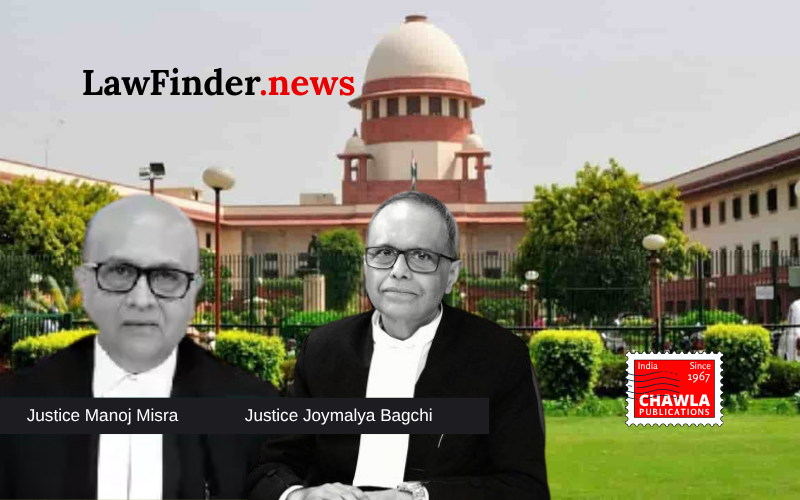
In a landmark ruling, the Supreme Court of India has set aside a judgment by the Bombay High Court, which had remanded a case back to the trial court due to perceived procedural lapses concerning an advocate's withdrawal of representation. The Supreme Court bench, comprising Justices Manoj Misra and Joymalya Bagchi, emphasized the restrictive use of the High Court's supervisory jurisdiction under Article 227 of the Constitution.
The case originated from a civil suit filed by Shri Digant against M/s. P.D.T. Trading Co. & Ors., which sought possession under the Maharashtra Rent Control Act, 1999. The trial court had proceeded with the case after the defendants' counsel submitted a 'no instructions' pursis, leading to a decree in favor of the plaintiff. The defendants' appeal, citing inadequate opportunity to present their case due to the lack of notice following the 'no instructions' claim, was dismissed by the appellate court.
However, the Bombay High Court intervened, asserting that the defendants were deprived of an opportunity to present their case due to the non-compliance with the procedural requirements for an advocate's withdrawal of appearance. The High Court set aside the trial court's judgment and remanded the matter for reconsideration.
The Supreme Court, upon appeal, scrutinized the appellate court's decision and the High Court's intervention. It observed that the advocate had not sought the withdrawal of the vakalatnama and that the defendants had ample time to engage new counsel, which they failed to do. The Supreme Court highlighted that the High Court's supervisory powers are to be exercised sparingly, only in cases of grave injustice or jurisdictional error, neither of which was present in this case.
The judgment clarifies the procedural expectations from advocates wishing to withdraw representation and reinforces the limits of the High Court's intervention in lower court proceedings, establishing a precedent for similar cases in the future.
Bottom Line:
High Court's supervisory jurisdiction under Article 227 of the Constitution is limited to correcting jurisdictional errors, grave injustice, or failure of justice. Mere errors by lower courts do not warrant interference.
Statutory provision(s): Articles 226/227 of the Constitution of India, Advocates Act, 1961, Maharashtra Rent Control Act, 1999, Civil Manual (Clause 660(4)), Bombay High Court Appellate Side Rules, 1960 (Rule 8(4)).
Shri Digant v. M/s. P.D.T. Trading Co., (SC) : Law Finder Doc Id # 2812389