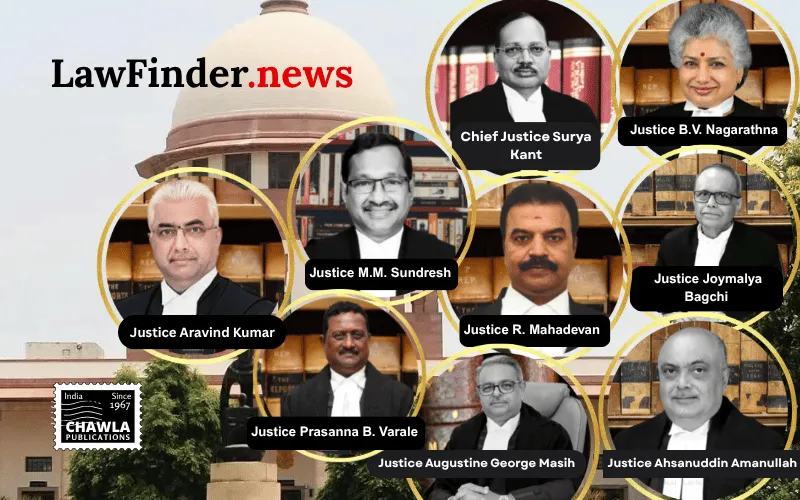
New Delhi, May 5 The Supreme Court on Tuesday observed that the practice of excommunicating Parsi women for entering into interfaith marriages is prima facie discriminatory.
A nine-judge bench headed by Chief Justice of India Surya Kant said the right of conscience under Article 25 (1) of the Constitution is a right by birth and cannot be taken away by marriage.
The bench, also comprising Justices B V Nagarathna, M M Sundresh, Ahsanuddin Amanullah, Aravind Kumar, Augustine George Masih, Prasanna B Varale, R Mahadevan and Joymalya Bagchi, was hearing petitions regarding discrimination against women at religious sites, including the Sabarimala temple in Kerala, as well as the scope of religious freedom across various faiths.
The Constitution bench is also examining the question whether the community's religious head's power to expel member(s) from religious life can coexist with the individual's right to profess and practice religion under Article 25.
During the hearing, senior advocate Darius Khambata, who was appearing for a Parsi Zoroastrian woman who married a Hindu man and faced excommunication from the Parsi community due to her interfaith marriage, said such practice is bad in law.
"I am a devotee, I have not forsaken my religion, I am a believer. Just because I have married (I have faced exclusion), that (an interfaith marriage) is not a crime," he submitted, adding that this was a man-made imposition on an otherwise progressive and great religion.
Justice Nagarathna said marriage is the basis of discrimination only if it is a case of a woman entering into marriage with a man from another faith.
The bench observed that such selective excommunication appears to have a discriminatory effect.
"The right of conscience under Article 25 (1) is a right by birth and cannot be taken away by marriage. In this case, marriage as a basis of classification is discriminatory against women," Justice Nagarathna observed.
Khambata submitted, "The same principle is not applied to a man. The same should apply both ways.
"And that could lead to huge ramifications not only for Parsi Zoroastrians but across the board. It would lead to some terrible consequences."
Justice Nagarathna further remarked that children of Parsi fathers have the benefit of the Zoroastrian religion because of birth.
"The same thing (should) apply to the wife also. It is a religion by birth; it cannot be taken away by marriage," she said.
Khambata also argued that the rights of a religious denomination under Article 26 of the Constitution are not wider than one's freedom to practice their religion or exercise their conscience under Article 25 of the Constitution of India.
"Both must be read harmoniously," he emphasised.
Justice Nagarathna said the two provisions of the Constitution form a compact and must be read together as they are the same right of religion.
"It is not a separate or distinct right that a denomination exercises. It cannot be dichotomised or divorced. A river cannot rise higher than its source; Article 26 rights cannot rise higher than an Article 25 (1) right," Khambata submitted, adding that Article 26 cannot give a higher right to religion or a lower right to religion.
The hearing remained inconclusive and would continue on Wednesday.
The reference to the nine-judge bench was made by the five-judge bench on the challenge to the 1962 verdict of the Bombay High Court which had upheld the power of excommunication as protected religious practice.