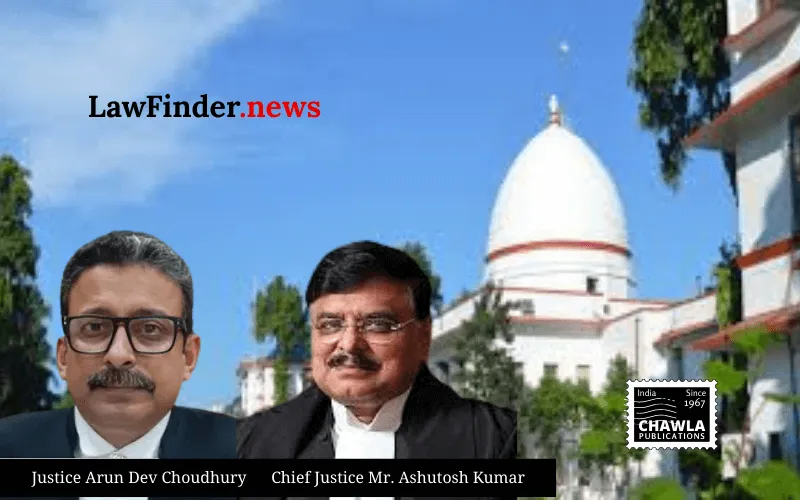
The Court rules that the N.C. Hills Autonomous Council lacks legislative competence under the Sixth Schedule to enact anti-defection laws, declaring Rule 18A ultra vires.
In a landmark decision, the Gauhati High Court has declared the anti-defection law enacted by the N.C. Hills Autonomous Council as unconstitutional. The judgment was delivered by Chief Justice Ashutosh Kumar and Justice Arun Dev Choudhury, who presided over the case. The court held that the N.C. Hills Autonomous Council does not possess the legislative power to enact laws concerning the disqualification of members on grounds of defection, a domain exclusively governed by the Tenth Schedule of the Indian Constitution.
The case was brought before the court by petitioners Suraj Naiding and others, challenging the constitutional validity of the "Constitution of N.C. Hills Autonomous Council (42nd Amendment) Act, 2017," which introduced Rule 18A. This rule sought to disqualify elected members of the Council for defection from their political parties. However, the court found that the Sixth Schedule of the Constitution does not confer legislative competence on the Council to legislate on anti-defection laws, as this field is occupied by the Tenth Schedule, providing a complete constitutional code on the subject.
The judgment emphasized that the doctrine of pith and substance cannot be applied to validate legislation on disqualification for defection, as it is a substantive constitutional matter outside the Council's enumerated powers under the Sixth Schedule. The court reaffirmed that Autonomous Councils are creations of the Constitution with limited and enumerated powers, unable to legislate on matters not expressly authorized.
The court's decision also highlighted the constitutional framework centralizing the law on defection within the Tenth Schedule, thereby barring parallel legislation by subordinate bodies like Autonomous Councils. The introduction of Rule 18A was seen as an encroachment upon a legislative field reserved for the Union Legislature.
This ruling comes as a significant reaffirmation of the constitutional limitations placed on Autonomous Councils in India, reinforcing the centralized nature of anti-defection laws under the Tenth Schedule. The judgment has broader implications for legislative practices within Autonomous Councils across the country, ensuring adherence to constitutional mandates.
The petitioners argued that the impugned amendment was a replica of the Tenth Schedule's provisions, highlighting that such legislative competence was not within the Council's jurisdiction. The court agreed, noting that the introduction of similar legislation in the Rajya Sabha remains pending scrutiny, further underscoring the lack of legislative competency in this area.
Ultimately, the Gauhati High Court's decision underscores the importance of maintaining constitutional integrity and the hierarchical distribution of legislative powers in India. By striking down Rule 18A, the court has reinforced the constitutional scheme, ensuring that laws governing defection remain centralized and consistent across the nation.
Bottom Line:
The N.C. Hills Autonomous Council lacks legislative competence to enact anti-defection laws under the Sixth Schedule of the Constitution as it is not a plenary legislature. Anti-defection matters fall within the constitutional domain of the Tenth Schedule and cannot be legislated upon by subordinate bodies like Autonomous Councils.
Statutory provision(s): Sixth Schedule to the Constitution of India, Tenth Schedule to the Constitution of India, Constitution of N.C. Hills Autonomous Council (42nd Amendment) Act, 2017
Suraj Naiding v. N.C. Hills Autonomous Council, (Gauhati)(DB) : Law Finder Doc id # 2897232