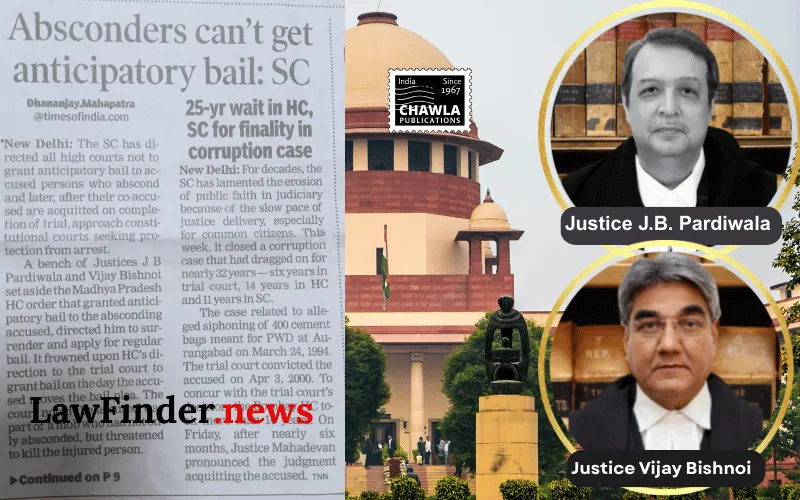
Supreme Court Sets Aside High Court's Decision Granting Anticipatory Bail to Absconding Accused, Balmukund Singh Gautam's Bail Reversed as Supreme Court Emphasizes Judicial Process Integrity
In a landmark decision, the Supreme Court of India has overturned the Madhya Pradesh High Court's order that granted anticipatory bail to Balmukund Singh Gautam, an accused in a politically charged criminal case. The apex court emphasized the importance of adhering to judicial processes and maintaining the integrity of the law, especially in cases involving absconding accused persons.
The case originated from a political rivalry incident on June 2, 2017, leading to multiple FIRs. Balmukund Singh Gautam, who was among the accused, had been absconding for nearly six years, prompting concerns about his potential influence on witnesses and the judicial process. Despite the acquittal of co-accused in the related FIR, the Supreme Court underscored that such acquittals do not automatically entitle absconding individuals to anticipatory bail.
The Supreme Court's bench, comprising Justices Vijay Bishnoi and J.B. Pardiwala, highlighted the erroneous application of the principle of parity by the High Court in granting bail based on co-accused acquittals. The bench noted that Gautam's prolonged evasion and threats to witnesses posed significant risks to justice and public safety.
The judgment also criticized the High Court's reliance on the absence of direct evidence against Gautam, reiterating that his absconding status and criminal antecedents warranted a cautious approach. The Supreme Court emphasized that anticipatory bail should not incentivize evasion of the judicial process and set a precedent that undermines law enforcement.
The Supreme Court directed Gautam to surrender within four weeks, allowing him the opportunity to seek regular bail thereafter, to be considered without prejudice from the current judgment. This decision reinforces the judiciary's stance on maintaining the sanctity of legal proceedings and the importance of cooperation with law enforcement.
Bottom Line:
Grant of anticipatory bail to an absconding accused sets a bad precedent and incentivizes evasion of judicial process - Absconding accused not entitled to anticipatory bail unless exceptional circumstances exist.
Statutory provision(s): Sections 438, 82, 83, 173 of the Criminal Procedure Code, 1973; Sections 427, 294, 323, 147, 148, 149, 307, 302 of the Indian Penal Code, 1860; Sections 25, 27 of the Arms Act, 1959
Balmukund Singh Gautam v. State of Madhya Pradesh, (SC) : Law Finder Doc id # 2853058